
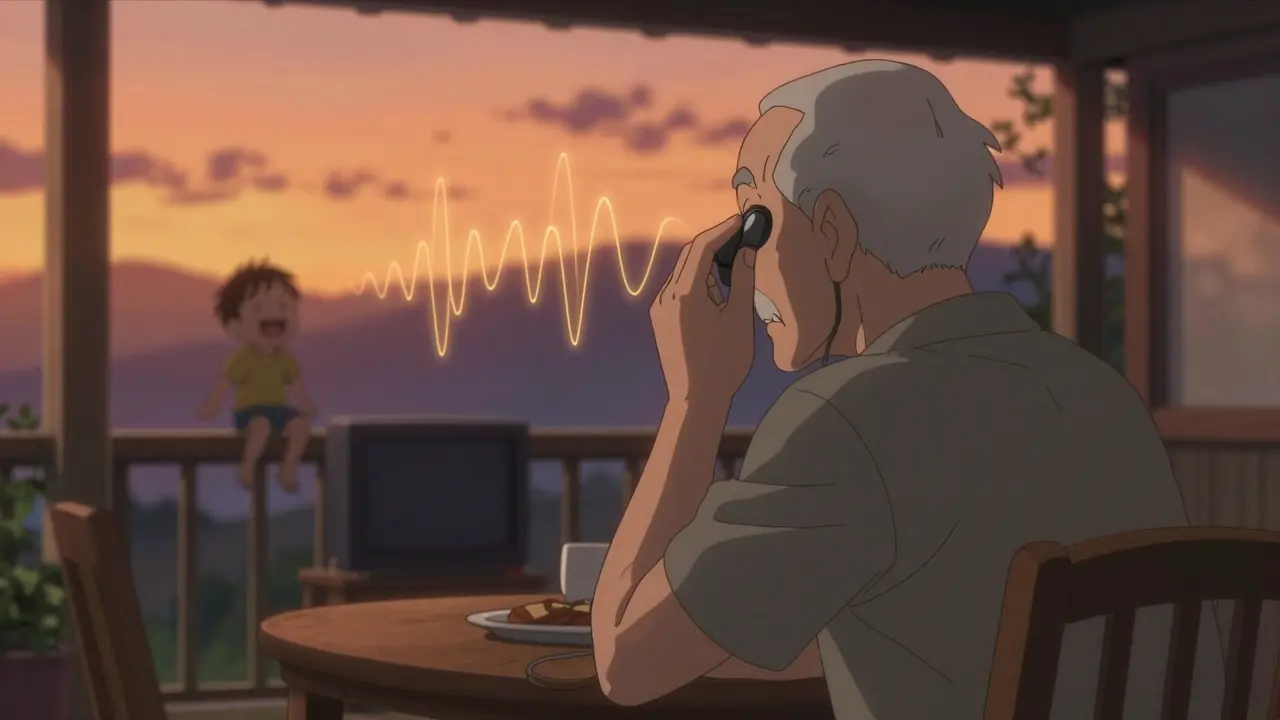
By the time you hit 65, chances are good that someone in your family - maybe even you - is struggling to hear the TV, asking people to repeat themselves, or turning up the volume until it’s louder than a normal conversation. This isn’t just about getting older. It’s presbycusis, the medical term for age-related hearing loss, and it’s not rare. In fact, about one in three people between 65 and 74 have it, and nearly half of those over 75 do. It doesn’t come on suddenly. It creeps in slowly, like a fog rolling in over the horizon. You don’t notice it until you realize you’ve stopped joining group chats, avoiding family dinners, or missing your grandchild’s laugh because the high notes just aren’t coming through anymore.
What Exactly Is Presbycusis?
Presbycusis (pronounced prez-buh-KYOO-sis) is a gradual loss of hearing in both ears due to aging. It’s not caused by earwax or infection. It’s damage deep inside the inner ear, where tiny hair cells - about 16,000 of them at birth - slowly die off and don’t come back. These hair cells are responsible for picking up sound vibrations and turning them into signals your brain can understand. Over time, especially after age 30, you lose about 1% of them each year. By the time you’re in your 70s, that adds up. The worst part? The first sounds you lose are the high-pitched ones: birds chirping, children’s voices, the beeps of a microwave, or the letters ‘s’ and ‘th’ in words like “sun” or “think.” That’s why you might hear someone talking but can’t make out what they’re saying. The words are there, but the details are gone.
It’s not just about volume. It’s about clarity. Studies show people with presbycusis can understand speech 25% worse in noisy places like restaurants compared to quiet rooms. And it’s not just your ears - your brain starts to struggle too. When you miss parts of conversation over and over, your brain stops trying to fill in the gaps. That’s why people with untreated hearing loss are 5.3 times more likely to feel socially isolated, and why depression rates jump by 32% in this group.
Why It’s More Than Just a Nuisance
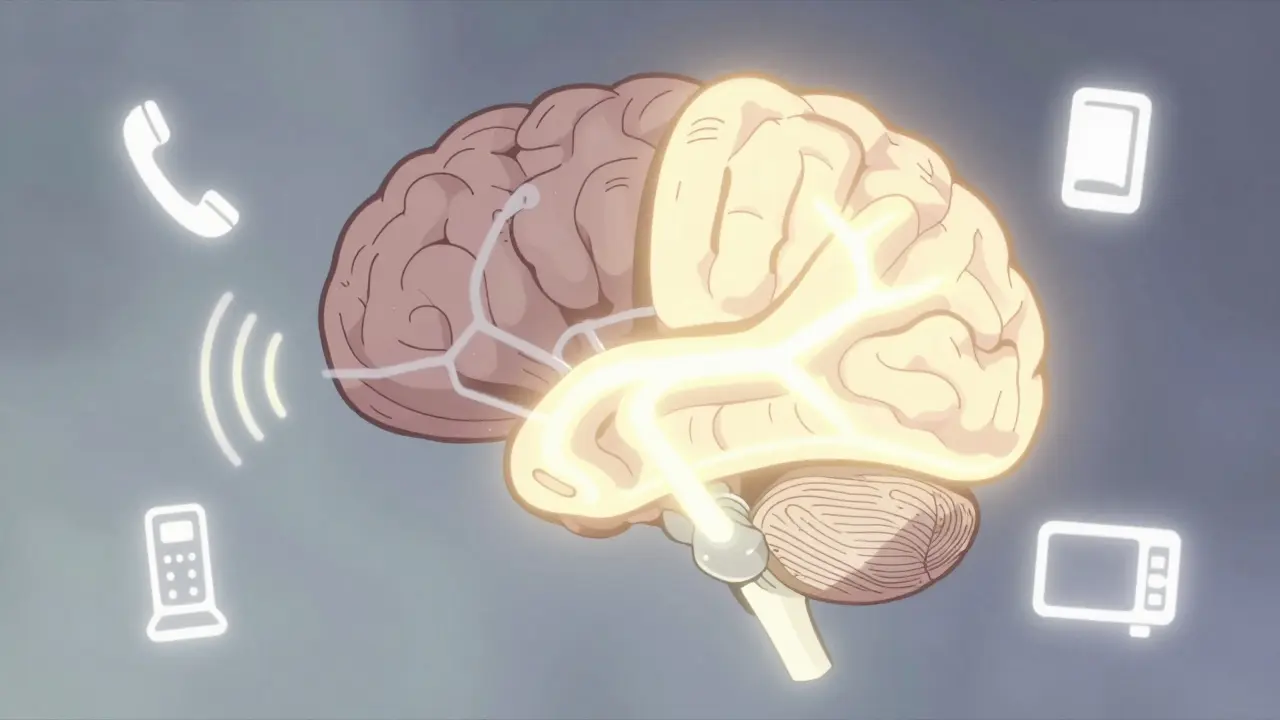
Most people think hearing loss is just annoying. But it’s far more dangerous than that. A major 2020 report from The Lancet linked untreated hearing loss to a 50% higher risk of developing dementia. Why? Because when your brain is constantly working to decode muffled speech, it’s overtaxed. That mental strain leaves less room for memory, focus, and processing. It’s like running your computer at 100% all day - eventually, things start to crash.
There’s also a safety issue. One in three older adults with untreated hearing loss report missing warning sounds - fire alarms, car horns, doorbells. A 2021 Johns Hopkins study found 37% had at least one incident where they didn’t hear a critical alert. That’s not just inconvenient. It’s life-threatening.
And the financial impact? Real. A 2021 analysis showed people with untreated hearing loss earn $30,000 less per year on average than their peers with normal hearing. Why? Because communication is everything at work. Missed instructions, misunderstood emails, avoiding meetings - it all adds up.
What Causes It? It’s Not Just Age
Yes, aging is the main factor, but it’s not the only one. Genetics play a big role - about 35 to 50% of cases are tied to specific genes like GRHL2 and GJB2. If your parents had hearing loss, you’re more likely to too.
But noise exposure matters a lot. Listening to loud music, working in construction, or even years of lawn mower use can speed up the damage. The World Health Organization says exposure to noise above 85 decibels for more than 8 hours a day increases your risk by 40%. That’s about the level of heavy city traffic.
Other health conditions make it worse. Diabetes increases your risk by 28%. High blood pressure by 23%. Smoking? That adds another 15%. These conditions damage blood flow to the inner ear, starving those delicate hair cells of oxygen. Even if you’re healthy otherwise, these hidden factors are quietly working against you.
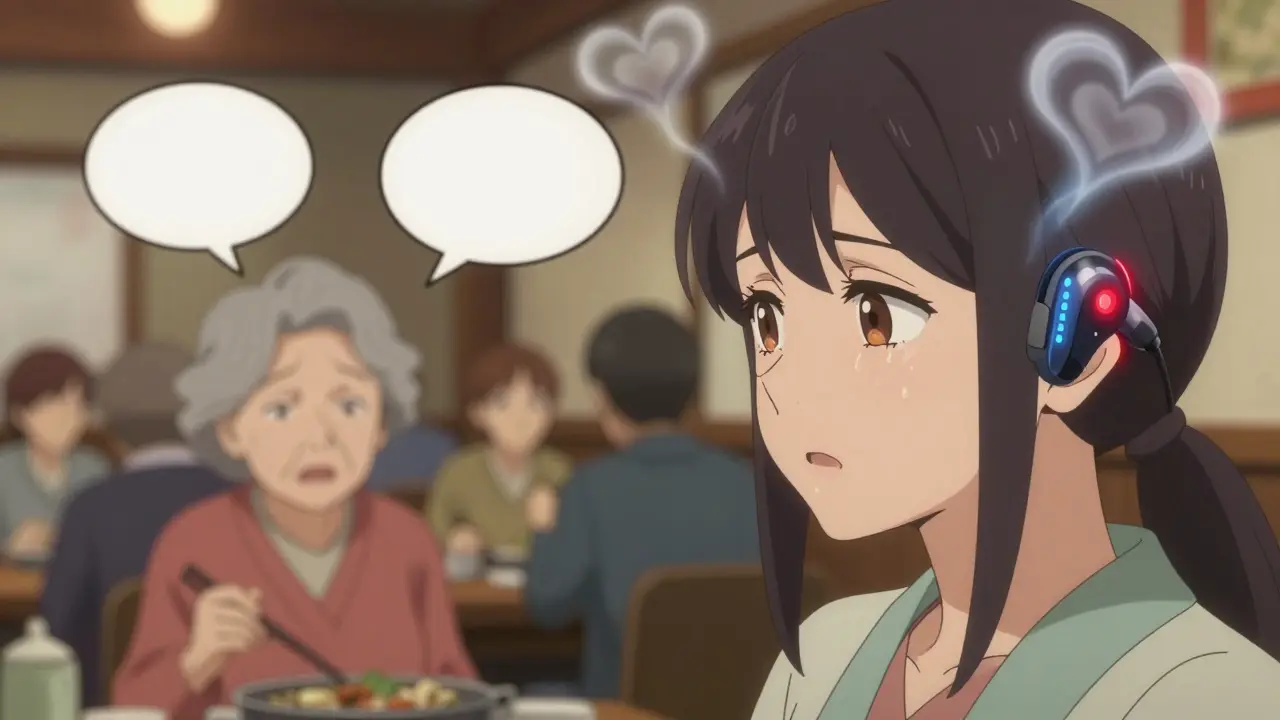
Amplification Isn’t Just a Fix - It’s a Lifeline
There’s no cure for presbycusis. But there’s something almost as powerful: amplification. Hearing aids don’t restore hearing to what it was. But they do restore connection.
Modern hearing aids are nothing like the bulky, whistling devices of the past. Today’s models are tiny computers. They have 16 to 64 frequency channels that adjust volume for specific pitches. Directional microphones focus on the person in front of you and reduce background noise by 3 to 6 decibels. Bluetooth lets you stream phone calls or TV audio straight to your ears. Some even track your steps or monitor how often you’re talking to others.
Studies show properly fitted hearing aids improve speech understanding by 40-60% in quiet settings and 25-40% in noisy ones. Eighty-five percent of users say their communication gets better. But here’s the catch: only 30% of people who need them actually use them. Why? Because many get them too late, or they’re poorly fitted.
One common mistake? Assuming all hearing aids are the same. Premium models like Phonak Paradise, Oticon More, or Signia Styletto cost $1,800 to $3,500 per ear and include advanced features like AI noise reduction. But now, thanks to the FDA’s 2022 rule, over-the-counter (OTC) hearing aids are available for $200 to $1,000. Brands like Jabra Enhance Select and Widex Moment have earned top ratings from Consumer Reports. OTC devices work well for mild to moderate loss - if you know your hearing level.
Getting Help: What Actually Works
Don’t wait until you’re struggling every day. The American Speech-Language-Hearing Association recommends a baseline hearing test at age 50, then every two years. If you’re already noticing trouble - asking for repeats, turning up the TV, avoiding conversations - get tested now.
A good audiologist won’t just sell you a device. They’ll do a full hearing evaluation, fit the device to your ear shape, and adjust it over time. Most clinics offer a 30- to 60-day trial. That’s important. You need time to adjust. Most people reach 80% comfort within 4 to 6 weeks. But learning to use smartphone apps or rechargeable features can take 12 hours of practice.
Fit matters more than you think. About 30% of people need custom ear molds because their ear canals are narrow or oddly shaped. A poor fit means feedback, discomfort, or weak sound. And maintenance? Batteries last 3 to 14 days, depending on usage. Rechargeable models give you 16 to 20 hours per charge. Clean them daily. Keep them dry. Store them in a case.
Telehealth is changing access. Sixty-two percent of audiology clinics now offer remote fine-tuning. You can adjust volume, change settings, or troubleshoot without leaving home. That’s huge for people in rural areas or with mobility issues.
What to Expect - And What Not To
Let’s clear up a myth: hearing aids won’t give you perfect hearing. They won’t make you hear like you did at 25. But they’ll give you back the moments that matter. The sound of your partner’s voice when they say “I love you.” The laughter of your grandkids. The clarity of a doctor’s instructions during a checkup.
Don’t expect instant perfection. The first week can be overwhelming. Sounds you haven’t heard in years - fridge hums, footsteps, rustling leaves - can feel too loud. That’s normal. Your brain needs time to relearn. Stick with it. Most people who quit do so within six months because of discomfort, poor fit, or unrealistic expectations.
And cost? It’s still a barrier. Sixty-eight percent of users pay more than $2,000 out of pocket. But things are changing. As of 2024, Medicare Advantage plans now cover hearing aids for 28 million beneficiaries. Private insurers are starting to follow. Don’t assume it’s unaffordable - ask your provider.
What’s Next? The Future of Hearing
The hearing aid market is growing fast. It’s expected to hit $14.7 billion by 2030. New tech is coming: AI that reduces listening effort by 20%, apps that test your hearing at home, and devices that track your social activity like a fitness tracker. One company even measures how often you’re talking to others - a silent warning sign if your social engagement drops.
The World Health Organization warns that without action, 1.5 billion people will have hearing loss by 2050. That’s more than the population of India. But the tools to fix it already exist. We just need to use them.
Is presbycusis the same as hearing loss from loud noise?
No. Presbycusis is caused by aging and natural wear of inner ear hair cells. Noise-induced hearing loss comes from exposure to loud sounds - like concerts or machinery - and can happen at any age. But the two often overlap. Someone who worked in construction for 30 years and is now 70 may have both types of damage. That’s why a full hearing evaluation is key.
Can hearing aids stop dementia?
They can’t stop it completely, but treating hearing loss early can reduce dementia risk by 8-10% over a decade, according to Dr. Frank R. Lin at Johns Hopkins. When your brain isn’t straining to hear, it has more energy for memory and thinking. That’s why starting hearing aids at 60 instead of 70 makes a measurable difference.
Are over-the-counter hearing aids good enough?
For mild to moderate hearing loss, yes - especially if you’ve had a hearing test and know your needs. Brands like Jabra Enhance Select and Eargo have strong reviews. But if you have trouble understanding speech in noise, have tinnitus, or have hearing loss in only one ear, see an audiologist. OTC devices aren’t designed for complex cases.
Why do some people stop using hearing aids?
The top reasons: poor fit (45%), discomfort (30%), and not hearing well in noisy places (25%). Many people get a device that doesn’t match their lifestyle. For example, someone who eats out often needs better noise filtering. Others don’t get enough follow-up. A good audiologist will adjust settings over time. Don’t give up after a week - give it 6 weeks.
How do I know if I need a hearing test?
Ask yourself: Do I often ask people to repeat themselves? Do I turn the TV up so loud others complain? Do I avoid group conversations? Do I hear ringing in my ears? If you answered yes to any of these, get tested. You don’t need a referral. Many clinics offer free screenings. The sooner you act, the better your results.
If you’ve been ignoring the signs, it’s not too late. Hearing loss doesn’t have to mean isolation. With the right support, the world can come back into focus - not with perfect clarity, but with the warmth of a loved one’s voice, the clarity of a conversation, and the peace of knowing you’re not missing out anymore.


Graham Holborn
Hi, I'm Caspian Osterholm, a pharmaceutical expert with a passion for writing about medication and diseases. Through years of experience in the industry, I've developed a comprehensive understanding of various medications and their impact on health. I enjoy researching and sharing my knowledge with others, aiming to inform and educate people on the importance of pharmaceuticals in managing and treating different health conditions. My ultimate goal is to help people make informed decisions about their health and well-being.