

Imagine taking your medication every day-until one morning, you just don’t. Not because you forgot. Not because you’re lazy. But because the voices in your head told you the pills are poison. Or because you can’t afford them. Or because the side effects made you feel worse than the illness. This isn’t rare. It’s the reality for 40% to 60% of people with mental health conditions who stop taking their prescribed drugs.
Why People Stop Taking Their Mental Health Medication
It’s easy to assume non-adherence is about forgetfulness or rebellion. But the reasons are deeper-and more human.For someone with schizophrenia, taking antipsychotics daily means accepting they have an illness. Many don’t feel sick. They feel misunderstood. The medication doesn’t erase the voices; it dulls them. And sometimes, that’s not enough. Studies show only about half of these patients stay on their meds long-term.
Depression makes everything harder. When you’re already drained, remembering to take pills feels like climbing a mountain. A major study found depression cuts adherence by 40%. For elderly patients, feelings of worthlessness or suicidal thoughts often override concerns about physical health.
Cost is another silent killer. A single antipsychotic can cost $300-$800 a month without insurance. In California, homeless patients with mental illness had only a 26% adherence rate-not because they didn’t care, but because they chose food over pills.
Dosing schedules matter too. If you need to take three pills at three different times a day, you’re more likely to miss one. One study found that 87% of patients stuck with once-daily regimens. Yet 73% said their doctor never even asked if simplifying their schedule was possible.
What Works: The Evidence Behind Real Solutions
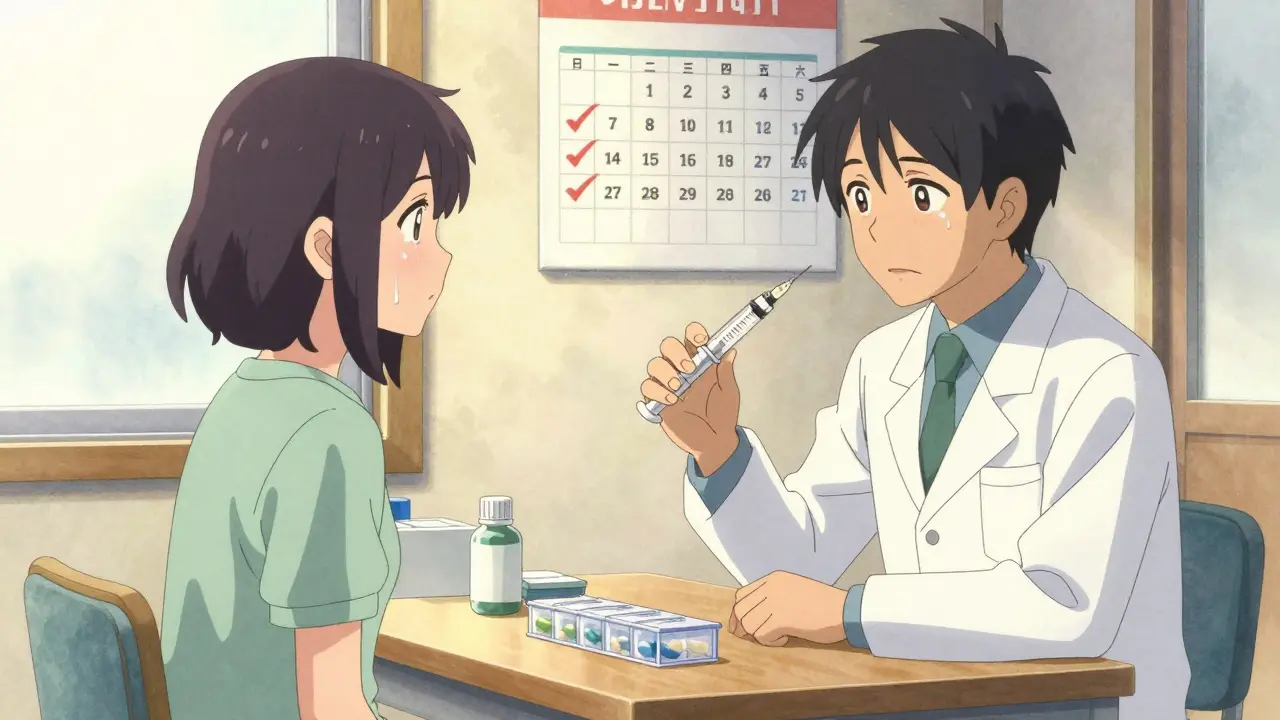
Not all interventions are equal. Some apps and reminders help a little. But the real breakthroughs come from human connection and systemic change.Pharmacist-led care is the most proven approach. In one randomized trial, patients working with a pharmacist and psychiatrist improved adherence by 1.67 points on a standardized scale-142% better than standard care. These pharmacists don’t just hand out pills. They sit down. They ask, “What’s stopping you?” They adjust doses. They negotiate with insurance. They help patients understand how the medication connects to how they feel.
Kaiser Permanente’s Northern California division saw a 32.7% jump in adherence after launching a pharmacist-led regimen management program. Hospitalizations dropped by 18.3%. Their CMS Star Rating went from 3.8 to 4.3. This wasn’t magic. It was teamwork.
Long-acting injectables are another game-changer. For patients who struggle with daily pills, a shot every two weeks or once a month can mean the difference between stability and crisis. A 2023 JAMA Psychiatry study found injectables achieved 87% adherence compared to just 56% for oral versions.
And it’s not just about the drug. It’s about the story behind it. One patient told me (in a Reddit thread from March 2025): “My pharmacist didn’t just give me my meds. She asked why I stopped. I cried. Then we made a plan.” That’s what sticks.
The Hidden Barriers: Insurance, Access, and System Failure
Even the best solutions fail if the system blocks them.Only 41% of community mental health centers that tried adding pharmacists to their teams kept the program after a year. Why? Workflow chaos. No funding. No training. Clinicians were overwhelmed. The system wasn’t built for this kind of care.
Insurance is the biggest wall. In the same Reddit survey, 64% of respondents said they couldn’t access pharmacist-led programs because insurance wouldn’t cover them. Meanwhile, Medicare Advantage plans now lose up to 8.2% of their payments if patients aren’t adherent. But those penalties don’t reach the people who need help-they hit the insurers, who then cut services.
And while digital tools like pill reminder apps are growing fast (the market will hit $58.7 billion by 2027), they’re useless if you don’t have a smartphone, data, or a safe place to keep your phone. Tech can’t fix poverty.
What You Can Do: Practical Steps for Patients and Families
You don’t need a perfect system to make a difference. Start small.- Ask your doctor: “Can we simplify my medication schedule?” One pill a day is easier than three.
- Request a long-acting injectable if you’re on antipsychotics and struggle with daily pills.
- Find a pharmacist who specializes in mental health. They’re trained to help with side effects, cost, and confusion-not just refill requests.
- Use a pill organizer with alarms. Not because you’re forgetful. Because your brain is tired.
- Talk to someone who’s been there. Support groups, whether in-person or online, reduce isolation-and isolation is a major reason people stop taking meds.
If you’re a caregiver, don’t nag. Ask: “What’s the hardest part about taking your meds right now?” Listen. Then help solve that one thing.
The Bigger Picture: Why This Isn’t Just a Patient Problem
Non-adherence isn’t a failure of willpower. It’s a failure of design.The CDC calls it an “invisible epidemic.” The New England Journal of Medicine says it causes 125,000 deaths a year in the U.S. alone. It contributes to 25% of all hospitalizations. And yet, most clinics don’t track it. Most doctors don’t ask about it. Most insurance plans don’t pay for solutions.
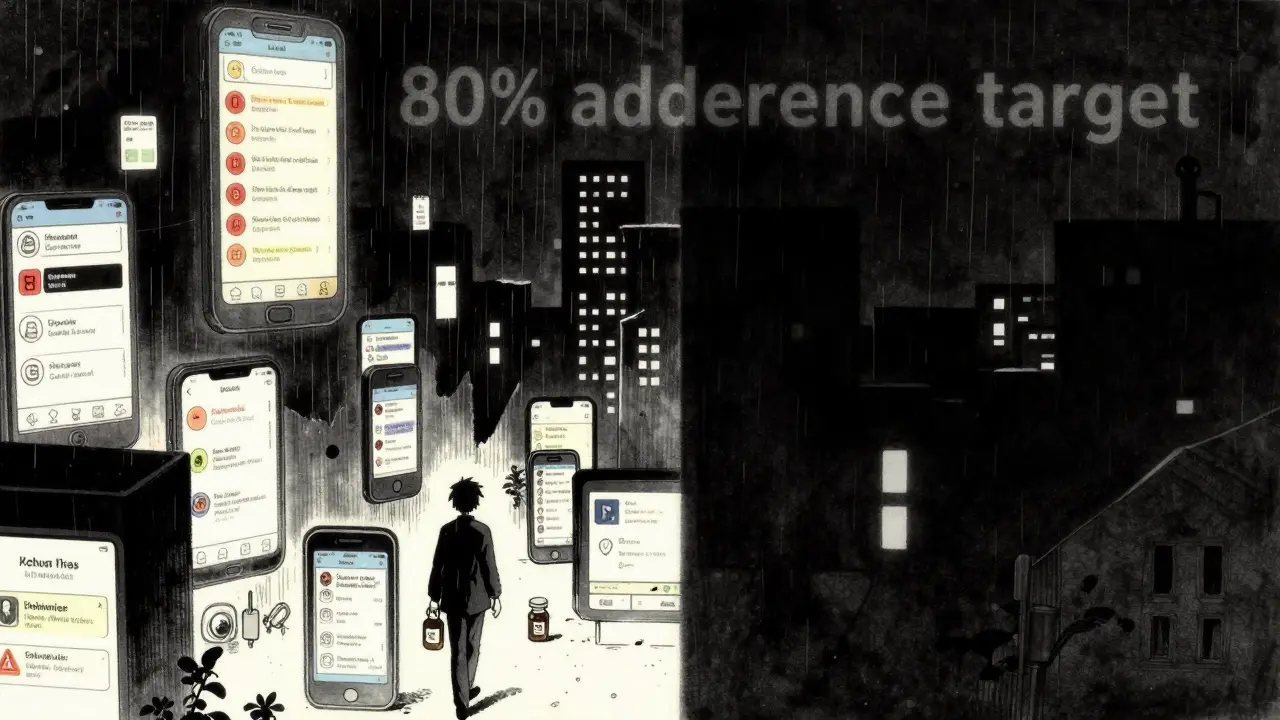
But things are shifting. CMS now uses the Proportion of Days Covered (PDC) metric to measure adherence. If your PDC falls below 80%, your provider’s reimbursement drops. That’s forcing change. UnitedHealthcare now ties 12% of mental health providers’ pay to adherence targets. Epic Systems is building real-time adherence alerts into their 2026 EHR update. AI can now predict when someone is likely to miss a dose-with 82% accuracy-using smartphone data like movement patterns and screen time.
These aren’t just tech fixes. They’re signals that the system is finally waking up.
What’s Next: Hope in the Data
The good news? We know what works.When you combine pharmacist support, simplified regimens, injectable options, and cost transparency, adherence rates climb. In one program targeting homeless patients, adherence jumped from 26% to 68% in six months. That’s not a miracle. That’s a model.
But progress depends on pushing for policy change. Demand that your provider offers Medication Therapy Management. Ask your insurer to cover long-acting injectables. Support legislation that funds mental health pharmacists in community clinics.
Medication adherence isn’t about compliance. It’s about dignity. It’s about letting someone live without choosing between their sanity and their survival.
Why do people with mental illness stop taking their medication?
People stop for many reasons: they don’t feel sick, the side effects are unbearable, they can’t afford the pills, the dosing schedule is too complex, or they feel stigmatized. Some believe the medication isn’t helping, or even that it’s harming them. Lack of insight into their illness, especially with conditions like schizophrenia, is a major factor. Depression also reduces motivation to take any medication.
Is medication non-adherence common in mental health?
Yes. Globally, 40% to 60% of people with mental health conditions don’t take their medication as prescribed. For schizophrenia, adherence is around 50%. Among homeless individuals, it drops to as low as 26%. These numbers are far worse than for conditions like diabetes or high blood pressure.
What’s the most effective way to improve medication adherence?
Pharmacist-led collaborative care is the most effective. When pharmacists work directly with psychiatrists and patients to simplify regimens, manage side effects, reduce costs, and provide education, adherence improves by up to 40%. Long-acting injectables also significantly increase adherence compared to daily pills.
Can digital apps help with mental health medication adherence?
Some apps help, but only a little-typically improving adherence by 1.8% to 2%. They’re useful as reminders, but they don’t solve the root causes like cost, side effects, or lack of insight. Apps work best when paired with human support, not as standalone solutions.
Are long-acting injectables better than daily pills for mental health?
Yes, for many people. A 2023 JAMA Psychiatry study found long-acting injectable antipsychotics achieved 87% adherence, compared to only 56% for daily oral pills. They’re especially helpful for those who struggle with memory, motivation, or stigma. They reduce the risk of relapse and hospitalization.
How can I get help if I can’t afford my mental health medication?
Talk to your pharmacist or doctor about patient assistance programs, generic alternatives, or long-acting injectables that may cost less over time. Many drug manufacturers offer free or discounted meds for low-income patients. Nonprofits like NAMI can also connect you with resources. Don’t stop taking your meds-ask for help instead.
Why don’t doctors talk about simplifying medication regimens?
Many doctors are under time pressure and don’t realize how much dosing frequency affects adherence. A survey found 73% of patients said their provider never asked about simplifying their regimen. But reducing from three doses a day to one can double adherence rates. It’s a simple change that requires no new drugs-just better communication.
What’s the goal for medication adherence in mental health?
The standard target is 80% adherence, measured by the Proportion of Days Covered (PDC). This means taking your medication on at least 80% of the days over a set period. Below that, the risk of relapse, hospitalization, and death rises sharply. Most mental health treatments are designed to work at this level.


Graham Holborn
Hi, I'm Caspian Osterholm, a pharmaceutical expert with a passion for writing about medication and diseases. Through years of experience in the industry, I've developed a comprehensive understanding of various medications and their impact on health. I enjoy researching and sharing my knowledge with others, aiming to inform and educate people on the importance of pharmaceuticals in managing and treating different health conditions. My ultimate goal is to help people make informed decisions about their health and well-being.