
Every time you pick up a prescription and see a much lower price than the brand-name version, you’re seeing the result of the ANDA-the Abbreviated New Drug Application. It’s not a fancy term, but it’s one of the most powerful tools in American healthcare for keeping drug prices low and medicines accessible. More than 9 out of 10 prescriptions filled in the U.S. today are for generic drugs, and nearly all of them got to market through this single regulatory pathway. So what exactly is an ANDA, and how does it let a $200 brand-name pill become a $5 generic overnight?
What an ANDA Actually Is
An ANDA is a formal request to the U.S. Food and Drug Administration (FDA) to approve a generic version of a brand-name drug. Unlike the original drug maker, who had to prove safety and effectiveness from scratch, a generic company doesn’t need to repeat expensive clinical trials. Instead, they prove their version is the same as the original-same active ingredient, same strength, same way it’s taken, and same effect on the body. The word "abbreviated" in ANDA means exactly that: it’s shorter, simpler, and cheaper because it builds on data the FDA already approved years ago.
The whole system started in 1984 with the Hatch-Waxman Act. Before then, generic drugs faced a legal gray area. Brand-name companies held patents and could block anyone else from making copies-even if the science was obvious. The law changed that. It created a clear path for generics to enter the market after patents expired, while still protecting innovation. The result? The FDA has approved over 11,000 generic drugs since then. Today, generics make up 90% of prescriptions but only 23% of total drug spending in the U.S.
How an ANDA Works: The Core Requirements
To get approval, a generic drug must match the brand-name drug in four key ways:
- Same active ingredient-The chemical that does the work in your body must be identical. No substitutes, no variations.
- Same dosage form-If the brand is a tablet, the generic must be a tablet. Same for capsules, injections, creams, or inhalers.
- Same strength-A 10mg pill must be 10mg. A 500mg capsule must be 500mg. No rounding up or down.
- Same route of administration-Oral, injection, topical-it has to be taken the same way.
That’s the easy part. The harder part is proving bioequivalence. This means the generic drug must enter your bloodstream at the same rate and in the same amount as the brand-name drug. The FDA doesn’t just take the company’s word for it. They require clinical studies-usually with 24 to 36 healthy volunteers. These people take both the brand and the generic, and blood samples are taken over time to measure how much of the drug is absorbed. The results must show that the generic’s absorption falls within 80% to 125% of the brand’s. That’s not a wide gap. It’s tight enough to ensure no meaningful difference in how the drug works.
ANDA vs. NDA: The Big Difference
Every new drug starts with an NDA-New Drug Application. That’s what Pfizer, Merck, or Roche files when they invent something never seen before. An NDA can take 10 to 15 years and cost over $2 billion. It includes animal studies, multiple phases of human trials, long-term safety data, and detailed manufacturing plans.
An ANDA? It’s nothing like that. It takes 3 to 4 years and costs between $1 million and $5 million. Why? Because it doesn’t repeat the clinical trials. The FDA already approved the original drug’s safety and effectiveness. The generic company only needs to prove they can make the same thing, consistently, and that it works the same way in the body.
This is why generics are so much cheaper. The brand-name company paid the full cost of discovery. The generic company just pays to copy it-accurately, safely, and at scale.
What’s Allowed to Be Different?
You might notice that generic pills look different from the brand. They might be a different color, shape, or have a different imprint. That’s fine. The inactive ingredients-like fillers, dyes, or coatings-can change. These don’t affect how the drug works. They’re just there to help with manufacturing, taste, or stability.
Labeling can also be slightly different. The generic can’t use the brand name. Instead, it lists the active ingredient and the manufacturer. But the warnings, dosing instructions, and safety information must be identical.
Even packaging can differ. You might get a bottle instead of a blister pack, or a different size box. As long as the drug inside is the same, the FDA approves it.
Why Some Drugs Don’t Get Generic Versions
Not every drug can have a generic. Complex drugs are the problem. Think inhalers, eye drops, topical creams, or injectables with special delivery systems. These aren’t just about the chemical. They’re about how the drug is delivered. For example, a generic asthma inhaler must deliver the exact same particle size and spray pattern as the brand. That’s hard to prove with blood tests alone.
The FDA calls these "complex generics," and they’re a growing challenge. Until recently, the ANDA process didn’t have clear rules for them. That’s why some drugs-like generic versions of EpiPens or Advair-took years longer to appear. The FDA has since created special guidance to help companies prove equivalence for these products, but it’s still tougher than for a simple tablet.
Drugs with a narrow therapeutic index are also tricky. These are medicines where even a tiny difference in blood levels can cause serious side effects or make the drug stop working. Think warfarin (blood thinner), lithium (for bipolar disorder), or levothyroxine (for thyroid). Even small variations in absorption can be risky. So while generics exist for many of these, the FDA watches them extra closely-and some doctors still prefer the brand.
The Numbers Behind the System
The ANDA system isn’t just theory. It’s saving billions every year.
- Generic drugs saved the U.S. healthcare system $313 billion in 2023 alone.
- Within a year of a generic launching, prices drop by 80% to 85%.
- 97% of generic drugs approved through ANDA are therapeutically equivalent to their brand-name counterparts.
- 724 generic drugs were approved in 2022, with an estimated $23.7 billion in annual savings.
And it’s not just about cost. It’s about access. Without ANDAs, millions of people couldn’t afford their medications. A study from Harvard found that when generics enter the market, adherence to treatment improves significantly-because people actually buy and take them.
How Long Does It Take?
The FDA aims to review a standard ANDA in 10 months under the Generic Drug User Fee Amendments (GDUFA). That’s faster than the review time for many new drugs. But it’s not always smooth. About 35% of ANDAs get a "complete response letter"-meaning the FDA says, "We need more info." The most common reasons?
- Manufacturing issues (32% of responses)-like unclear quality controls or inconsistent production methods.
- Insufficient bioequivalence data (27% of responses)-often because the study design didn’t meet FDA standards.
- Patent or exclusivity conflicts-sometimes the brand still has legal protection, even after the patent expires.
Companies with dedicated regulatory teams have a 42% first-time approval rate. Those without? Only 28%. That’s why big generic manufacturers like Teva, Mylan (Viatris), and Sandoz dominate the market. They’ve built teams that know exactly what the FDA wants.
What Happens After Approval?
Once approved, the FDA assigns each ANDA a unique six-digit number-like ANDA 214455 for the generic version of Eliquis. That number stays with the drug forever, even if the manufacturer changes. The drug is added to the FDA’s Orange Book, which lists all approved generics and their therapeutic equivalence ratings.
And then the real competition begins. The first company to file an ANDA that challenges a patent gets 180 days of exclusive rights to sell their version. That’s why you often see multiple generic versions hit the market all at once-they’re racing to be first.
Once that exclusivity ends, prices drop even further. It’s not unusual for a drug to go from $200 to under $10 within a year after multiple generics enter.
The Future of ANDA
The FDA is pushing to improve the process. Under GDUFA IV, they’re aiming for 90% of ANDAs to get approved on the first try by 2027. Right now, it’s around 65%. They’re also expanding guidance for complex generics-like nasal sprays and transdermal patches-which are growing fast.
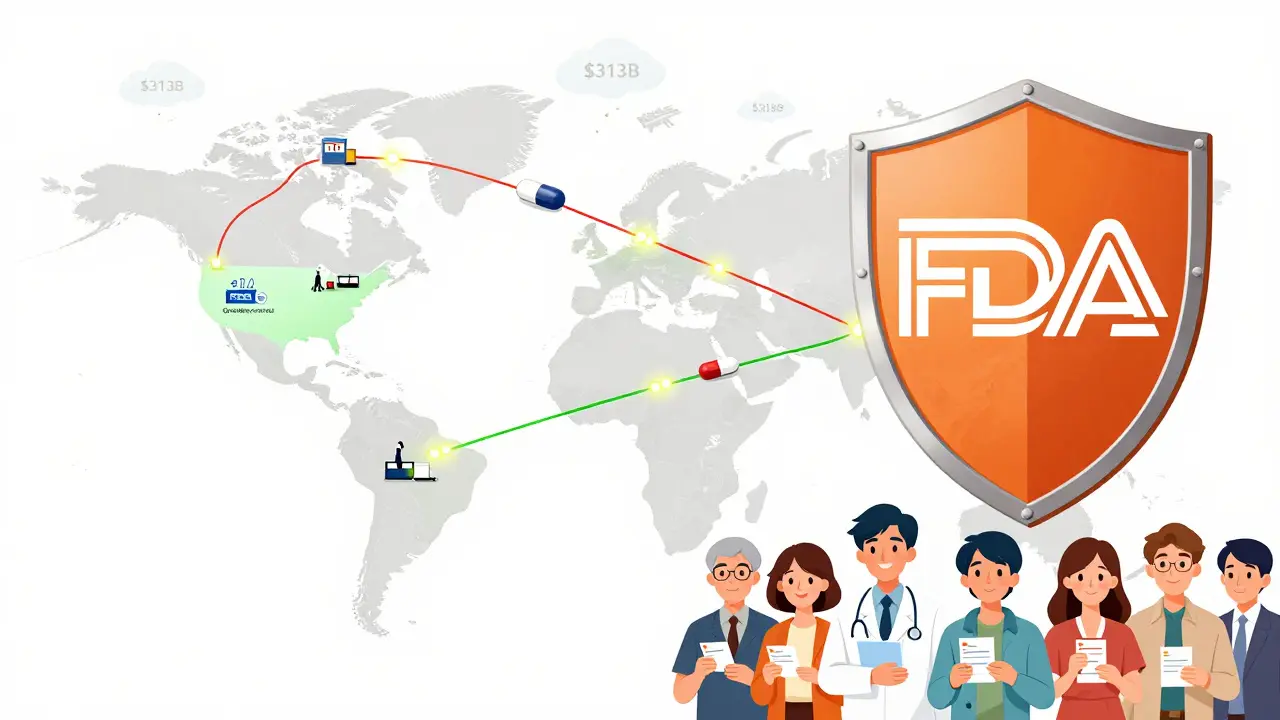
But there are risks. Over 80% of generic drug ingredients come from just two countries: India and China. If a factory shuts down due to quality issues-or a natural disaster, or political tension-supply chains break. That’s happened before. In 2019, a shortage of a common blood pressure drug hit the U.S. because the only approved manufacturer in India had an FDA warning.
Still, the ANDA system remains one of the most successful public health policies ever created. It balances innovation with affordability. It lets companies compete without reinventing the wheel. And it puts life-saving drugs within reach of everyone, not just those who can afford brand-name prices.
If you’ve ever saved money on a prescription, you’ve benefited from the ANDA. It’s not glamorous. It’s not flashy. But it works-and it’s keeping millions of Americans healthy, one generic pill at a time.
Is a generic drug the same as the brand-name drug?
Yes, in every way that matters. A generic drug must contain the same active ingredient, strength, dosage form, and route of administration as the brand-name drug. It must also be bioequivalent-meaning it works the same way in your body. The only differences are in inactive ingredients, packaging, or appearance, none of which affect safety or effectiveness.
Why are generic drugs so much cheaper?
Generic manufacturers don’t have to repeat expensive clinical trials. They rely on the FDA’s existing approval of the brand-name drug’s safety and effectiveness. This cuts development time from 10-15 years to 3-4 years and reduces costs from billions to just millions. The savings are passed on to consumers.
Can I trust the quality of generic drugs?
Absolutely. The FDA requires generic manufacturers to meet the same strict quality standards as brand-name companies. All facilities-whether in the U.S., India, or elsewhere-must pass the same inspections. In fact, many brand-name companies also make generic versions of their own drugs.
Why do some doctors still prescribe brand-name drugs?
For most drugs, generics are just as effective. But for a small number of medications with narrow therapeutic indexes-like warfarin or thyroid hormone-even tiny differences in absorption can matter. Some doctors prefer the brand for these, especially when starting treatment. But many switch patients to generics once stability is confirmed.
How do I know if a generic is available for my drug?
Check the FDA’s Drugs@FDA database or the Orange Book online. Your pharmacist can also tell you if a generic is approved and available. If your prescription says "dispense as written," you’ll need to ask your doctor to change it to "generic allowed" to use the cheaper version.
Do ANDAs apply to biologics or biosimilars?
No. ANDAs are only for small-molecule chemical drugs. Biologics-like insulin, vaccines, or cancer drugs made from living cells-follow a different pathway called the Biologics License Application (BLA). Biosimilars, which are similar to biologics, use a separate approval process under the BPCIA, not the Hatch-Waxman Act.


Graham Holborn
Hi, I'm Caspian Osterholm, a pharmaceutical expert with a passion for writing about medication and diseases. Through years of experience in the industry, I've developed a comprehensive understanding of various medications and their impact on health. I enjoy researching and sharing my knowledge with others, aiming to inform and educate people on the importance of pharmaceuticals in managing and treating different health conditions. My ultimate goal is to help people make informed decisions about their health and well-being.