
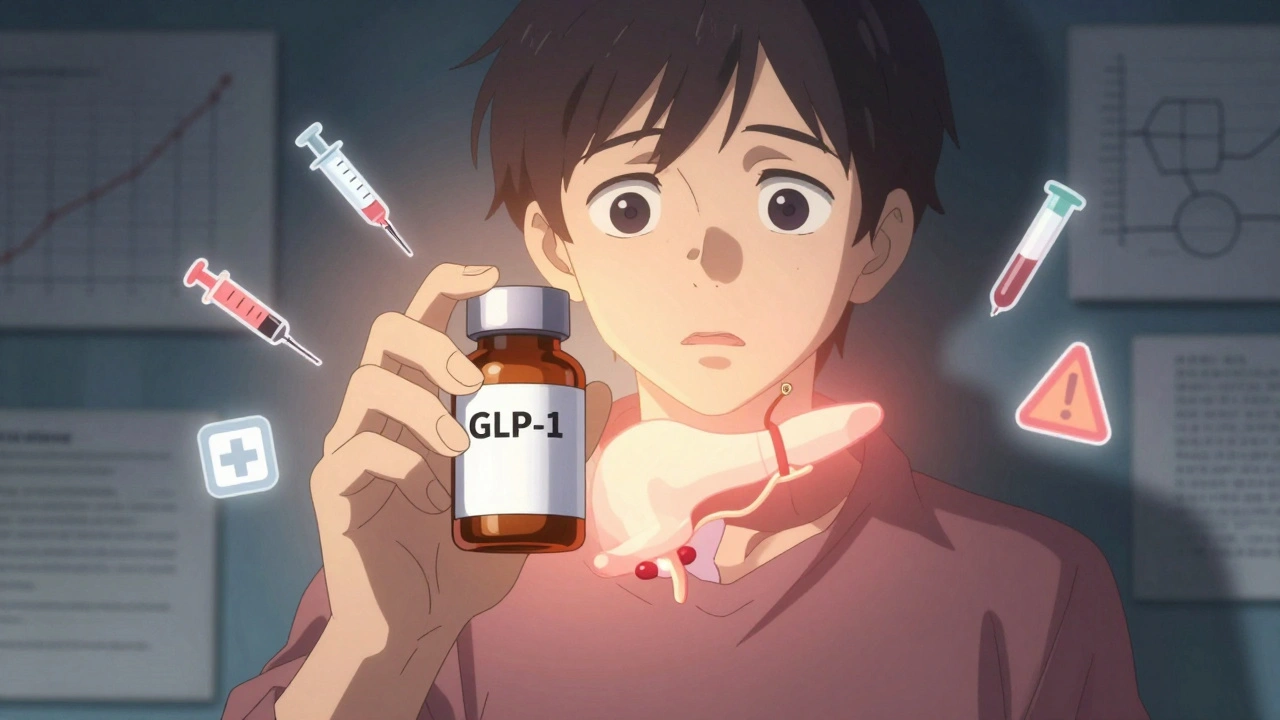
When you start taking a GLP-1 agonist like Ozempic or Wegovy for weight loss or diabetes, you’re not just signing up for better blood sugar control or faster weight loss-you’re also stepping into a conversation that’s still unfolding in medical journals and clinics worldwide. The big question on many minds: Does this drug raise my risk of pancreatitis? The answer isn’t simple. Some studies say yes. Others say no. And some suggest it might even lower your risk. So what do you actually need to watch for? And if you’re worried, what else can you try?
What Are GLP-1 Agonists, Anyway?
GLP-1 agonists are drugs that mimic a natural hormone in your body called glucagon-like peptide-1. This hormone tells your pancreas to release insulin when your blood sugar rises, slows down how fast food leaves your stomach, and makes you feel full sooner. That’s why these drugs help with both diabetes and weight loss.
Common ones include liraglutide (Victoza, Saxenda), semaglutide (Ozempic, Wegovy), and tirzepatide (Mounjaro, Zepbound). They’ve exploded in popularity-semaglutide alone brought in nearly $20 billion in global sales in 2023. But with that rise came questions. Early reports after their approval in the mid-2000s flagged possible links to pancreatitis, leading the FDA to require warning labels. Since then, the science has gotten more complex.
The Pancreatitis Risk Debate: Contradictory Evidence
Here’s where things get messy. In May 2025, a massive study of nearly a million diabetic patients found that GLP-1 agonists were linked to a 34% higher risk of acute pancreatitis within six months and a 45% higher risk of chronic pancreatitis over five years. That sounds alarming.
But then, in February 2025, another study-this one involving nearly a million people too-found the exact opposite. It showed no meaningful increase in pancreatitis risk. In fact, the lifetime risk for users was slightly lower than non-users. How can both be true?
The answer lies in how the studies were done. One looked at real-world data from insurance records. Another used clinical trial data with stricter controls. One adjusted for obesity and smoking. Another didn’t. And then there’s the JAMA study from 2023 that found GLP-1 users had a risk of pancreatitis nearly 9 times higher than those on bupropion-naltrexone. But that study only included about 5,000 people total. Small samples can make rare events look bigger than they are.
Meanwhile, a 2024 study presented at ENDO showed something surprising: GLP-1 agonists might actually reduce the chance of pancreatitis coming back in people who’ve had it before. That directly contradicts the long-standing fear that these drugs trigger flare-ups.
Who’s Actually at Risk?
Not everyone is equally vulnerable. Experts now believe the risk isn’t about the drug class as a whole-it’s about who you are.
- If you’ve had pancreatitis before, your risk of having it again isn’t higher with GLP-1 agonists, according to the American College of Gastroenterology.
- If you smoke, drink heavily, or have very high triglycerides (above 500 mg/dL), your risk goes up.
- People with advanced kidney disease are more vulnerable.
- Interestingly, having a BMI over 36 might actually protect you.
That last point is critical. It suggests the body’s metabolic state-how fat you are, how inflamed your system is-might matter more than the drug itself. This isn’t just about taking a pill. It’s about your whole health picture.
What Symptoms Should You Watch For?
Even if your risk is low, you need to know the warning signs. Acute pancreatitis doesn’t sneak up. It hits hard.
- Sudden, severe pain in your upper abdomen-often described as a “band” of pain wrapping around your belly.
- Pain that radiates to your back.
- Nausea and vomiting that won’t go away.
- Pain that gets worse after eating.
These symptoms show up in 92% of cases. If you feel this way after starting a GLP-1 agonist, don’t wait. Go to the ER. Pancreatitis can turn dangerous fast, especially if it’s hemorrhagic or necrotizing-types that damage tissue and can be life-threatening.
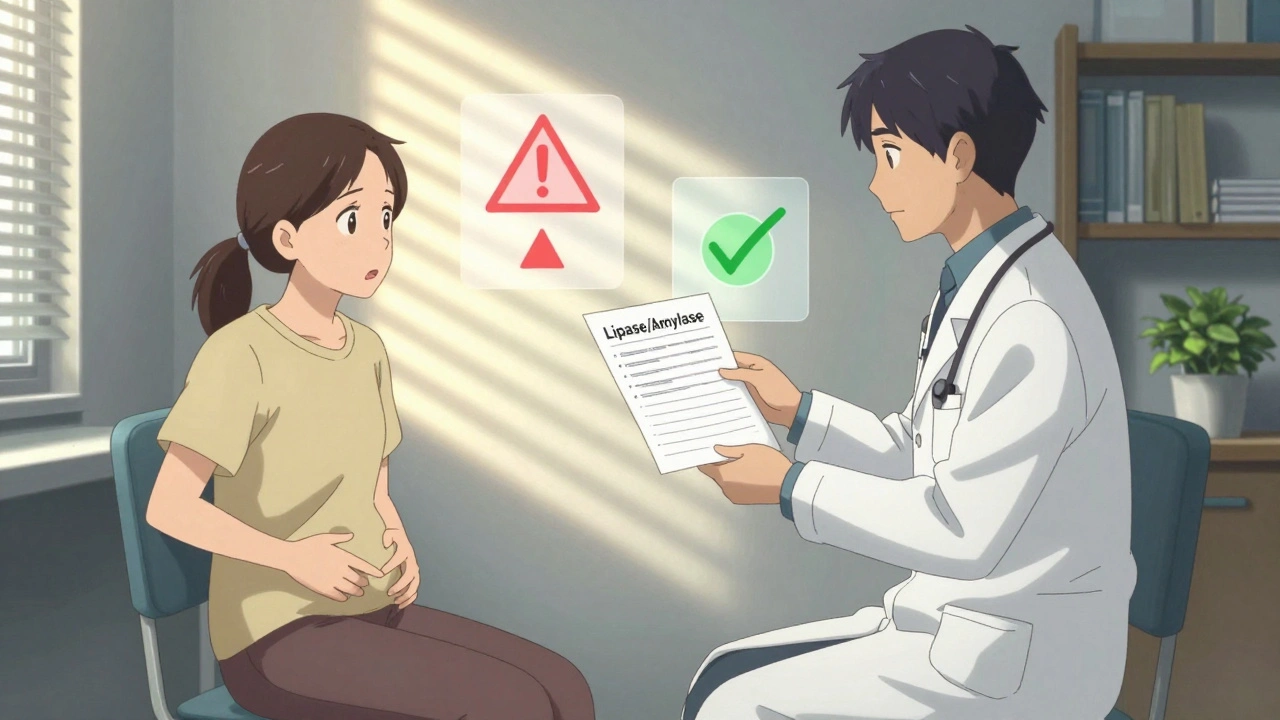
Doctors don’t routinely test your lipase and amylase levels unless you have risk factors. But if you’ve had pancreatitis before, or if you smoke and have high triglycerides, ask your doctor about baseline blood tests before starting treatment. Follow-up testing every 3 months in the first year might make sense for high-risk patients.
Alternatives If You’re Concerned
If you’re worried about pancreatitis-or your doctor thinks you’re at higher risk-there are other options.
SGLT2 Inhibitors
Drugs like empagliflozin (Jardiance), dapagliflozin (Farxiga), and canagliflozin (Invokana) work by making your kidneys flush out sugar through urine. They’re great for heart and kidney protection in diabetics. Studies suggest they don’t raise pancreatitis risk-and may even lower it compared to GLP-1 agonists.
Metformin
The oldest, cheapest, and most studied diabetes drug out there. It doesn’t cause weight gain, doesn’t cause low blood sugar, and has a pancreatitis risk of about 0.15 per 1,000 patient-years. That’s extremely low. If your main goal is blood sugar control and you don’t need major weight loss, metformin is still the gold standard.
DPP-4 Inhibitors
These include sitagliptin (Januvia) and saxagliptin (Onglyza). But here’s the catch: saxagliptin has a black box warning for pancreatitis. Sitagliptin? No increased risk found in large trials. So if you’re considering this class, pick sitagliptin and avoid saxagliptin.
Bupropion-Naltrexone (Contrave)
This combo is approved for weight loss and has been shown to have far lower pancreatitis risk than GLP-1 agonists. But it’s not for everyone. It’s not safe if you have a history of seizures, eating disorders, or are taking certain antidepressants. Also, it can cause nausea and headaches.
Orlistat (Xenical)
It blocks fat absorption in your gut. That means less calorie uptake-and less weight gain. But the side effects? Oily stools, frequent bowel movements, gas with discharge. Many people quit because it’s just too messy. Still, it doesn’t touch your pancreas.
Emerging Options
Tirzepatide (Mounjaro) is a dual GIP/GLP-1 agonist. It’s powerful for weight loss and blood sugar, but since it works through GLP-1 receptors, the pancreatitis question isn’t fully settled. The FDA is requiring long-term safety studies that won’t finish until 2027.
Researchers are now working on next-gen GLP-1 drugs that avoid pancreatic receptors entirely. But none are in human trials yet.

What Should You Do?
If you’re on a GLP-1 agonist and feeling fine-no pain, no vomiting-don’t panic. The absolute risk of pancreatitis is still very low. Most studies put the lifetime risk between 0.1% and 0.4%. That’s less than 1 in 200 people.
But if you have any of these risk factors:
- History of pancreatitis
- Smoking
- Heavy alcohol use
- Triglycerides over 500 mg/dL
- Advanced kidney disease
talk to your doctor about whether the benefits still outweigh the risks. Ask about switching to metformin or an SGLT2 inhibitor. If you’re using it for weight loss and not diabetes, ask: Is the extra 10-20 pounds of weight loss worth the potential risk?
And if you’re just starting out? Get a baseline blood test. Know the symptoms. Don’t ignore abdominal pain. And remember: the goal isn’t just to lose weight-it’s to stay healthy while you do it.
Regulators Are Watching
The FDA has received over 1,800 reports of pancreatitis linked to GLP-1 drugs since 2005. But here’s the catch: most of these are just reports. They don’t prove the drug caused the problem. Diabetics already have a higher baseline risk of pancreatitis due to obesity, high triglycerides, and inflammation.
The European Medicines Agency reviewed the data in early 2024 and concluded: “The benefits continue to outweigh the risks.” That’s the official stance. But they didn’t remove the warning. Why? Because science isn’t settled.
What’s clear is this: we’re moving away from treating GLP-1 agonists as a one-size-fits-all solution. We’re moving toward personalized medicine. Who you are matters more than the drug label.
Final Takeaway
GLP-1 agonists are powerful tools. They’ve changed lives. But they’re not risk-free. The pancreatitis concern isn’t a myth-it’s not a scare tactic either. It’s a real, low-probability event that’s more likely in certain people. The key is knowing your risk, watching your body, and having honest conversations with your doctor.
If you’re doing well on the drug and have no risk factors, keep going. If you’re unsure, or you’ve got red flags in your health history, explore alternatives. There’s no shame in switching. Your pancreas matters just as much as your scale.
Do GLP-1 agonists like Ozempic and Wegovy cause pancreatitis?
Some studies show a small increased risk, especially in people with existing risk factors like smoking, high triglycerides, or prior pancreatitis. Other large studies show no increase at all. The overall risk is low-between 0.1% and 0.4% over a lifetime. It’s not a guaranteed side effect, but it’s a real possibility that needs monitoring.
What are the symptoms of pancreatitis from GLP-1 drugs?
Symptoms include sudden, severe upper abdominal pain that may radiate to your back, nausea, vomiting, and pain that gets worse after eating. If you experience these after starting a GLP-1 agonist, seek medical attention immediately. Don’t wait to see if it passes.
Should I stop taking my GLP-1 agonist if I’m worried about pancreatitis?
Don’t stop abruptly without talking to your doctor. If you have no symptoms and no major risk factors, the benefits likely still outweigh the risks. But if you smoke, have high triglycerides, or have had pancreatitis before, discuss alternatives like metformin, SGLT2 inhibitors, or bupropion-naltrexone. Your doctor can help you weigh the trade-offs.
Are there safer alternatives to GLP-1 agonists for weight loss?
Yes. Metformin has minimal pancreatitis risk and helps with modest weight loss. SGLT2 inhibitors like Jardiance and Farxiga are neutral or protective. Bupropion-naltrexone (Contrave) has much lower pancreatitis risk than GLP-1 drugs but isn’t suitable for everyone due to psychiatric contraindications. Orlistat is safe for the pancreas but causes uncomfortable digestive side effects.
Does having had pancreatitis before mean I can’t take GLP-1 agonists?
No. Recent research from the American College of Gastroenterology shows that people with a history of acute pancreatitis are not at higher risk of recurrence when starting a GLP-1 agonist. This is a major shift from older guidelines. Your past pancreatitis shouldn’t automatically rule out these drugs-but you should still be monitored closely.
How often should I get blood tests for pancreatitis risk?
If you have risk factors-like smoking, high triglycerides, or prior pancreatitis-your doctor may recommend checking lipase and amylase levels every 3 months during the first year. For low-risk patients, testing is only needed if symptoms appear. Routine screening for everyone isn’t recommended by current guidelines.


Graham Holborn
Hi, I'm Caspian Osterholm, a pharmaceutical expert with a passion for writing about medication and diseases. Through years of experience in the industry, I've developed a comprehensive understanding of various medications and their impact on health. I enjoy researching and sharing my knowledge with others, aiming to inform and educate people on the importance of pharmaceuticals in managing and treating different health conditions. My ultimate goal is to help people make informed decisions about their health and well-being.