
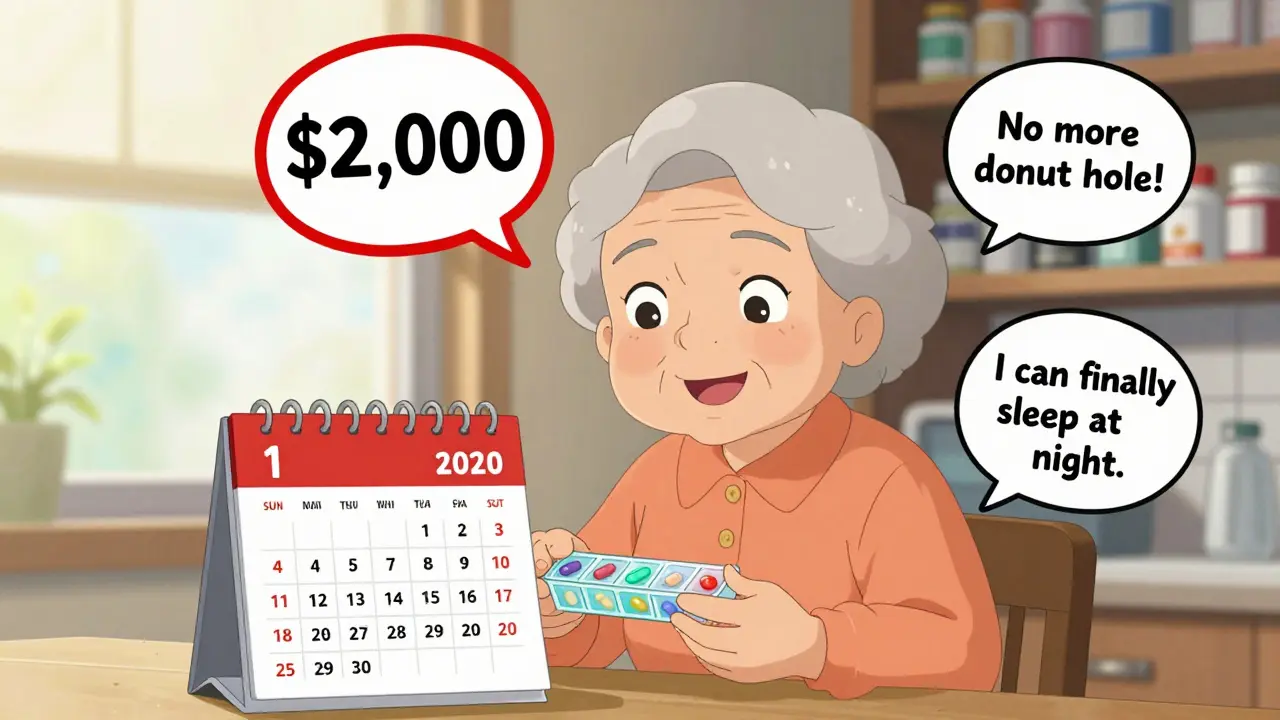
If you’re on Medicare and take prescription drugs, you’ve probably heard about Part D-but do you really understand how it works in 2025? The system changed dramatically last year, and many beneficiaries are still confused. The good news? You won’t pay more than $2,000 out of pocket for your medications this year, no matter how expensive they are. That’s a huge shift from just a few years ago, when people could end up paying thousands more just because they hit the infamous "donut hole."
What Medicare Part D Actually Covers
Medicare Part D is prescription drug coverage you get through private insurance companies that follow Medicare’s rules. It’s not automatic-you have to sign up. It covers both brand-name and generic drugs, including common ones like blood pressure pills, insulin, cholesterol meds, and even high-cost cancer treatments. But not every drug is covered in every plan. Each plan has its own list, called a formulary, which ranks drugs into tiers based on cost.
Most plans use a five-tier system: preferred generics (lowest cost), generics, preferred brand-name drugs, non-preferred brand-name drugs, and specialty drugs (highest cost). If your drug is on a higher tier, you pay more. That’s why it’s critical to check your plan’s formulary every year, even if you’re happy with it. A drug you take could move tiers-or get dropped entirely.
The New 2025 Coverage Phases (No More Donut Hole)
Before 2025, Medicare Part D had four phases: deductible, initial coverage, coverage gap (the donut hole), and catastrophic coverage. The donut hole was a nightmare. Once you and your plan spent a certain amount on drugs, you’d suddenly have to pay way more-sometimes 75% of the cost-until you hit an even higher spending threshold. Many people skipped doses or went without because they couldn’t afford it.
In 2025, that’s gone. Now there are only three phases:
- Deductible phase: You pay 100% of your drug costs until you hit $590. This is up from $505 in 2024, but it’s still manageable for most.
- Initial coverage phase: After you meet the deductible, you pay 25% of the cost for covered drugs. Your plan pays 65%, and drug manufacturers give a 10% discount. This phase ends when your total out-of-pocket spending (including what you pay and the manufacturer discount) hits $2,000.
- Catastrophic coverage phase: Once you hit $2,000, you pay nothing for the rest of the year. Ever. No coinsurance, no copays. The plan pays 60%, the manufacturer pays 20%, and Medicare pays 20%.
That $2,000 cap is the biggest change. It doesn’t matter if your insulin costs $300 a month or your cancer drug costs $10,000-you’ll never pay more than $2,000 total for your meds in 2025. That’s a game-changer for people with chronic conditions.
What You Still Pay: Premiums, Deductibles, and Copays
Even though your drug costs are capped at $2,000, you still pay monthly premiums. These vary widely. The average stand-alone Part D plan (PDP) costs $45 a month. Medicare Advantage plans with drug coverage (MA-PDs) average just $7. That’s a huge difference. But here’s the catch: lower premiums often mean higher out-of-pocket costs for drugs. A $0 premium plan might have high copays or a narrow pharmacy network.
Some people qualify for Extra Help-a federal program that lowers premiums, deductibles, and copays. If you get Medicaid, SSI, or have limited income, you might already be enrolled. If not, check your eligibility. In 2025, 90 stand-alone Part D plans are available with $0 premiums for people getting Extra Help.
Insulin is still capped at $35 per month, no matter what plan you’re on. That hasn’t changed since 2023. If you take insulin, you’re protected. But if you’re on other specialty drugs-like those for multiple sclerosis or rheumatoid arthritis-you’ll need to check your plan’s coverage carefully.

How to Pick the Right Plan for Your Meds
Choosing a Part D plan isn’t like picking a phone plan. You can’t just go by price. You have to match your specific drugs to the plan’s formulary.
Here’s how to do it:
- Make a list of every drug you take, including the exact name, dosage, and how often you take it.
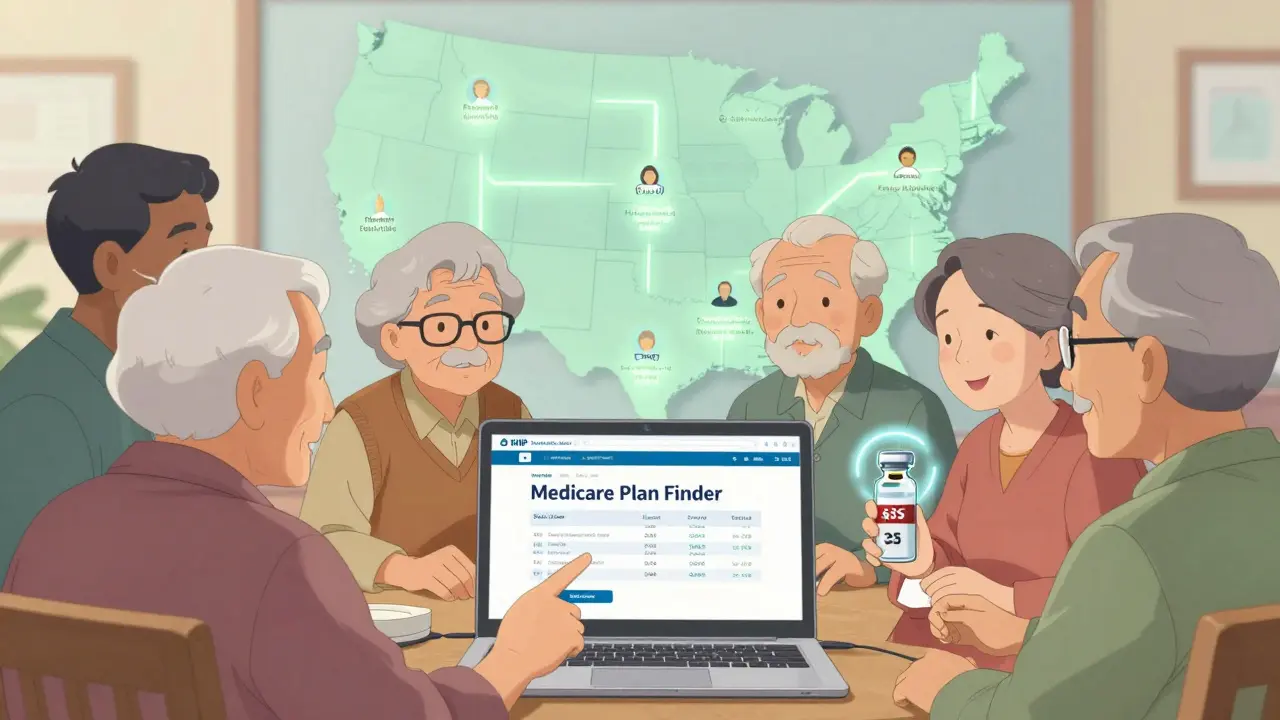
- Go to Medicare.gov/plan-compare (the Medicare Plan Finder tool).
- Enter your zip code, your drugs, and your preferred pharmacy.
- Sort by "Total Annual Cost"-not just monthly premium.
That total cost includes your premium, deductible, and estimated copays for your meds. You might be surprised. A plan with a $10 premium could cost you $2,000 more in drug costs than a $40 premium plan if your drugs aren’t covered well.
Also, check the pharmacy network. Some plans only cover certain pharmacies. If your local CVS or Walgreens isn’t in-network, you could pay double-or get denied coverage.
When to Enroll (And When You Risk a Penalty)
You don’t have to sign up for Part D when you first get Medicare. But if you wait and don’t have other creditable drug coverage (like from an employer), you’ll pay a late enrollment penalty forever.
The penalty is 1% of the national base premium ($35.37 in 2024) for every month you delay. That adds up. If you wait a year, you’ll pay an extra $4.24 per month for as long as you have Part D. That’s over $50 extra per year. It’s not worth the risk-even if you don’t take drugs now.
The best time to enroll is during your Initial Enrollment Period (7 months around your 65th birthday). If you miss it, your next chance is the Annual Enrollment Period: October 15 to December 7. Changes take effect January 1.
There’s also a Special Enrollment Period if you lose other drug coverage-like if you retire and lose employer benefits. Don’t wait. Act right away.
What People Are Saying (And What They’re Missing)
Many beneficiaries are thrilled about the $2,000 cap. One woman in Ohio said, "I used to skip my heart meds in the donut hole. Now I can take them without fear. I’m sleeping better."
But confusion is still common. On Reddit, someone wrote: "I thought the $2,000 cap meant I’d pay no more than $2,000 total-but my plan still has a $50 monthly premium on top of that." That’s true. The cap is only for drug costs, not premiums. Premiums are separate.
Another issue: 68% of Medicare beneficiaries didn’t know about the 2025 changes, according to the Medicare Rights Center. That’s a lot of people still thinking they’re stuck in the donut hole. Don’t be one of them.
What’s Coming Next
The $2,000 cap isn’t permanent. In 2026, it rises to $2,100-and then it will adjust yearly based on inflation. That’s by design. The goal is to keep the cap meaningful as drug prices rise.
Experts also warn that while the cap helps, it doesn’t fix the root problem: sky-high drug prices. Manufacturers still set list prices, and even with the 10% discount, some drugs are still outrageously expensive. The government is negotiating prices for a small number of high-cost drugs starting in 2026, but that’s just a start.
For now, the $2,000 cap is your shield. Use it wisely.
Need Help? Here’s Where to Go
You don’t have to figure this out alone.
- Call 1-800-MEDICARE (1-800-633-4227). They handled 78 million calls in 2023.
- Find your local State Health Insurance Assistance Program (SHIP). They offer free, one-on-one counseling. In 2023, they helped 5.2 million people.
- Use the Medicare Plan Finder tool. It’s free, official, and updated daily.
Don’t guess. Don’t assume. Check your plan every year. Your health-and your wallet-depend on it.
Is the $2,000 out-of-pocket cap for Medicare Part D per year or lifetime?
It’s annual. The $2,000 cap resets every January 1. You’ll pay up to $2,000 for your prescription drugs each calendar year, no matter how many you take or how expensive they are. After you hit that limit, you pay nothing for covered drugs for the rest of the year.
Do I still need Medicare Part D if I don’t take any medications right now?
Yes, unless you have other creditable drug coverage. If you go without Part D for more than 63 days after your Initial Enrollment Period and don’t have other coverage, you’ll pay a late enrollment penalty forever. That penalty is added to your monthly premium. Even if you’re healthy now, your needs could change. A low-premium plan can protect you from future costs.
Does the $35 insulin cap apply to all insulin types?
Yes. The $35 monthly cap applies to all FDA-approved insulin products covered under Medicare Part D, regardless of brand or type-whether it’s rapid-acting, long-acting, or intermediate. This cap is built into every Part D plan and doesn’t depend on your tier or plan choice.
What happens if my drug gets removed from my plan’s formulary?
Your plan must give you at least 60 days’ notice before removing a drug. You can request a formulary exception to keep the drug covered, or switch to a similar drug. During Annual Enrollment (October 15-December 7), you can switch plans to one that covers your medication. If you’re affected mid-year, contact your plan or call 1-800-MEDICARE for help.
Can I use any pharmacy with my Medicare Part D plan?
No. Each plan has its own network of pharmacies. Some plans include major chains like CVS, Walgreens, and Walmart. Others limit you to mail-order or regional pharmacies. Always check if your pharmacy is in-network before you fill a prescription. Out-of-network pharmacies may charge you full price, and you won’t get credit toward your $2,000 out-of-pocket cap.
How do I know if I qualify for Extra Help?
You may qualify if your income is below $21,870 for an individual or $29,580 for a couple in 2025, and your resources (like bank accounts and investments) are under $17,220 for an individual or $34,360 for a couple. If you get Medicaid, SSI, or a Medicare Savings Program, you’re automatically enrolled. You can apply online at SSA.gov or call Social Security at 1-800-772-1213.


Graham Holborn
Hi, I'm Caspian Osterholm, a pharmaceutical expert with a passion for writing about medication and diseases. Through years of experience in the industry, I've developed a comprehensive understanding of various medications and their impact on health. I enjoy researching and sharing my knowledge with others, aiming to inform and educate people on the importance of pharmaceuticals in managing and treating different health conditions. My ultimate goal is to help people make informed decisions about their health and well-being.