

When someone with Parkinson’s disease starts experiencing hallucinations or delusions, doctors face a tough choice. Give them an antipsychotic to calm the psychosis? That could make their tremors and stiffness worse. Keep them on levodopa to control movement? That might make the hallucinations explode. This isn’t just a tricky case-it’s a biological tug-of-war happening inside the brain, where two life-saving drugs are literally fighting each other.
How Levodopa Works-And Why It Gets Risky
Levodopa is the gold standard for treating Parkinson’s. It’s not dopamine itself, but the building block your brain uses to make dopamine. In healthy people, dopamine is released in a steady, controlled way. In Parkinson’s, the brain cells that produce dopamine die off. Levodopa steps in to replace what’s lost. But here’s the catch: as the disease progresses, the brain loses its ability to regulate dopamine levels. What used to be a smooth, steady supply becomes a rollercoaster. A single dose can spike dopamine levels way beyond what’s normal, especially in patients who develop uncontrolled movements (dyskinesias). PET scans show these spikes can be twice as high in advanced Parkinson’s compared to early stages. This isn’t just a side effect-it’s a fundamental shift in how the brain responds to the drug.How Antipsychotics Block Dopamine-And Why That’s a Problem
Antipsychotics like haloperidol, risperidone, and quetiapine work by sticking to dopamine D2 receptors and blocking them. This reduces the overactivity in brain circuits linked to hallucinations and delusions. But in Parkinson’s, those same D2 receptors are already underused because there’s not enough dopamine around. When you block them further, motor control suffers. Studies show that even low doses of antipsychotics can worsen Parkinson’s symptoms by 25-35% on standard movement scales. It’s like trying to fix a broken car by turning off the fuel gauge-you might stop the alarm, but the engine still won’t run.The Clinical Catch-22
About 30-40% of people with Parkinson’s eventually develop psychosis. That’s more than 1 million people in the U.S. alone. Yet, treating it is risky. A 2022 survey of 150 movement disorder specialists found that 89% avoid older antipsychotics like haloperidol entirely. Even the safer options, like quetiapine, still cause motor worsening in 30-50% of patients. One patient in a Cleveland Clinic case report saw their tremor jump from 2/10 to 8/10 within two days of starting 0.25 mg of quetiapine. That’s not rare. Reddit threads from Parkinson’s communities are full of similar stories-people who got better sleep or fewer hallucinations but lost the ability to walk without help.And it goes both ways. If someone with schizophrenia is misdiagnosed and given levodopa for suspected Parkinson’s (maybe due to slow movement from antipsychotic side effects), their psychosis can flare up. A 1988 study showed 60% of schizophrenia patients had worse hallucinations and paranoia after just 300 mg of levodopa. One Reddit user, "MindfulSchizo," described how levodopa for restless legs brought back hallucinations they’d been free of for two years. This isn’t speculation-it’s repeatable, documented, and predictable.
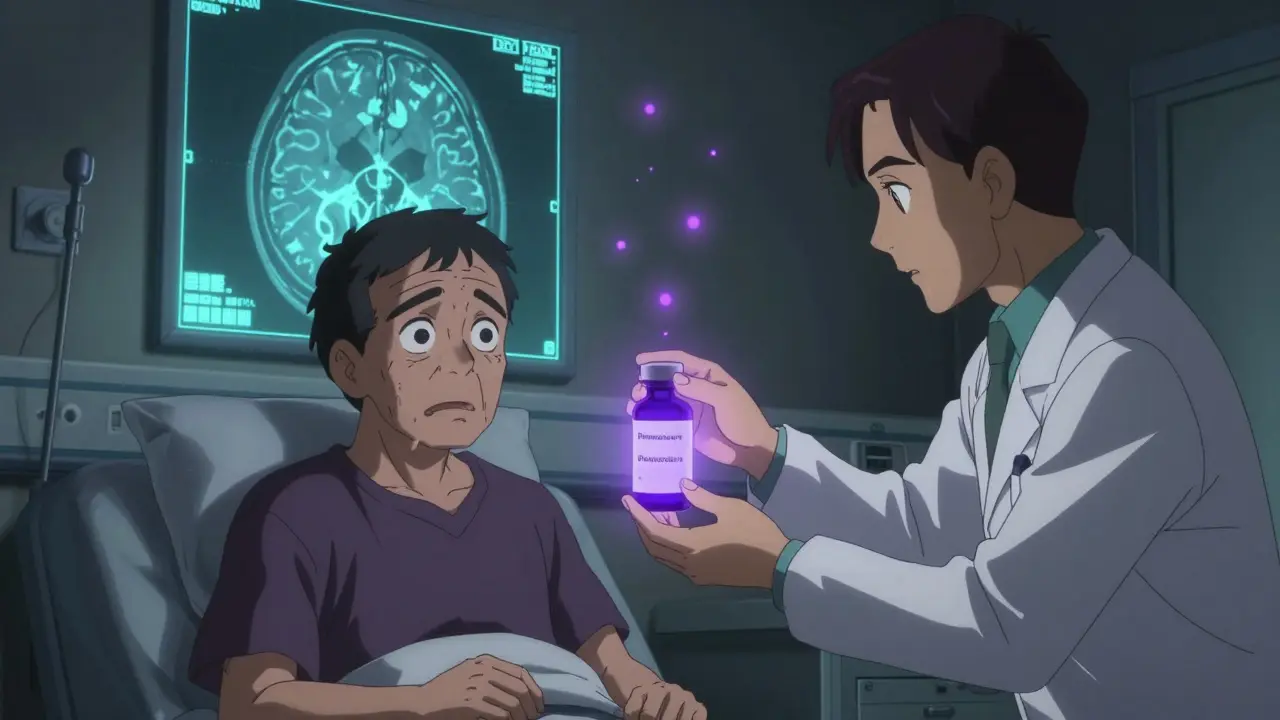
Why Some Antipsychotics Are Safer (But Not Safe)
Pimavanserin (brand name Nuplazid) is the only antipsychotic approved specifically for Parkinson’s psychosis. It doesn’t block dopamine at all. Instead, it targets serotonin receptors (5-HT2A), which somehow calms psychosis without touching motor control. It’s not perfect-some patients still get dizziness or swelling-but it’s the best option we have. Sales hit $434 million in 2022, showing how big the need is. Yet, 65% of Parkinson’s patients with psychosis still get no treatment because doctors fear the side effects. That’s a huge gap.Quetiapine is still used, but only at very low doses (12.5-75 mg/day). Even then, motor symptoms often worsen. Clozapine is effective for psychosis in schizophrenia, but it’s dangerous in Parkinson’s-up to 70% of patients develop severe stiffness or even a life-threatening condition called neuroleptic malignant syndrome (NMS). NMS can cause high fever, muscle rigidity, and organ failure. It’s rare, but when it happens in Parkinson’s patients on antipsychotics, the death rate is 10-20%.
The Hidden Danger of Stopping Levodopa
Here’s something many don’t realize: suddenly stopping levodopa can be just as dangerous as adding antipsychotics. If a patient’s levodopa is cut too fast-maybe because they’re being switched to another drug-their dopamine levels crash. That can trigger NMS, too. The Cleveland Clinic warns that abrupt levodopa withdrawal is a known trigger. And once NMS happens, dopamine agonists are needed to reverse it. It’s a vicious loop: treat psychosis → worsen movement → stop levodopa → trigger NMS → need dopamine drugs to fix it.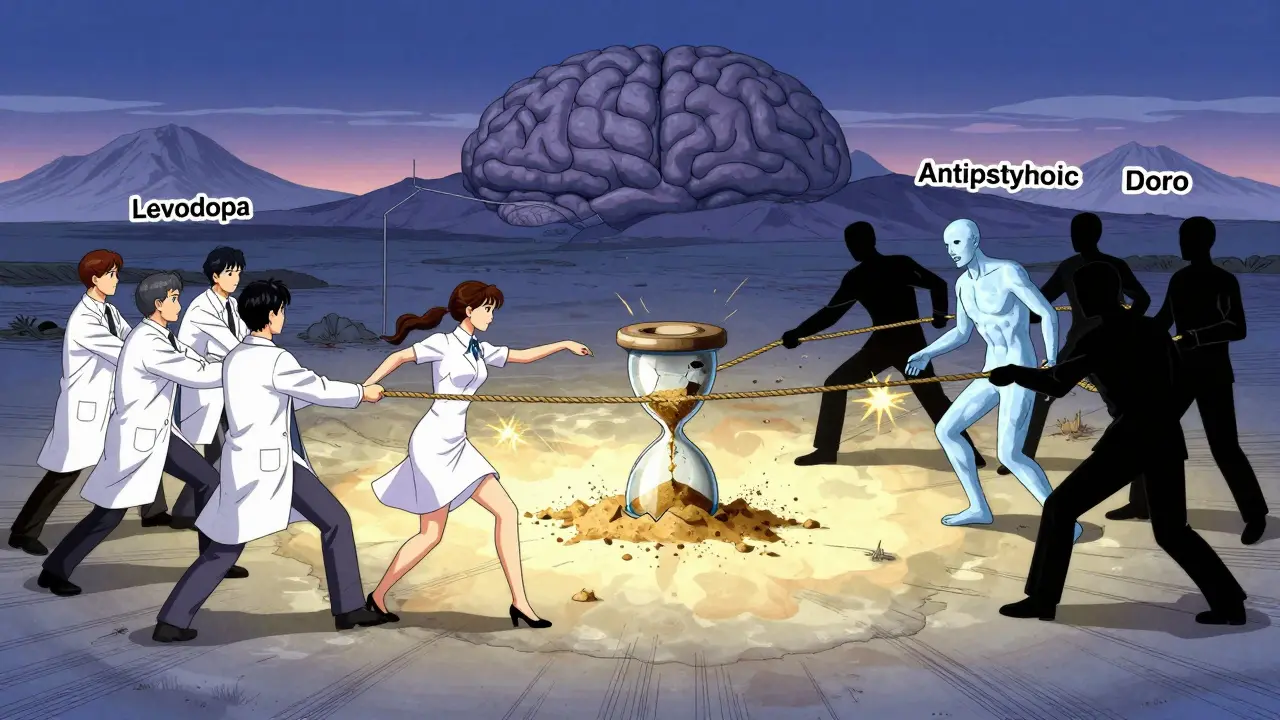
What’s Changing in Treatment
The field is moving away from dopamine manipulation. A 2023 trial of KarXT-a drug that acts on muscarinic receptors instead of dopamine-showed a 25% reduction in psychosis without worsening movement. That’s huge. Researchers at the Van Andel Institute are also testing drugs that target alpha-synuclein, the protein that clumps in Parkinson’s brains. If they can stop the disease’s root cause, maybe we won’t need to mess with dopamine at all.Imaging is also helping. The PPMI study, tracking over 1,500 Parkinson’s patients, found that if a person’s dopamine transporter (DAT) scan shows levels below 1.5 SUVr, they have an 80% chance of severe motor worsening if given antipsychotics. If their brain shows early signs of amyloid buildup (a sign of Alzheimer’s-like changes), they’re 75% more likely to have psychosis worsen from levodopa. This isn’t science fiction-it’s real, usable data that can guide treatment decisions today.
What Doctors Are Doing Now
Good clinicians don’t just guess. They monitor. At the Cleveland Clinic, when a Parkinson’s patient starts any antipsychotic, they check movement scores daily for two weeks. If UPDRS scores jump more than 15 points, the drug is stopped immediately. They also track psychosis with tools like PANSS or BPRS. A change of 10 points or more means something’s off. Most general neurologists don’t feel trained to do this. Only 38% say they’re confident managing Parkinson’s psychosis. Fellowship-trained specialists? 89% say they are.The bottom line: you can’t treat psychosis in Parkinson’s like you treat it in schizophrenia. You can’t treat Parkinson’s like you treat psychosis. The brain’s dopamine system is too finely tuned. The goal isn’t to pick one drug over the other-it’s to avoid the conflict entirely. That means using non-dopamine drugs when possible, monitoring closely, and never making changes without a clear plan.
What You Should Know If You’re Affected
If you or a loved one has Parkinson’s and psychosis:- Don’t assume antipsychotics are safe just because they’re prescribed.
- Track motor symptoms daily-tremor, stiffness, walking speed.
- Report any sudden worsening of movement or mood immediately.
- Ask if pimavanserin or KarXT is an option.
- Never stop levodopa without medical supervision.
If you have schizophrenia and develop movement problems:
- Don’t assume it’s just a side effect of antipsychotics.
- Ask if a dopamine scan or neurological exam is needed.
- Never take levodopa unless under strict supervision.
Can levodopa cause psychosis in someone without Parkinson’s?
Yes. While levodopa is mainly used for Parkinson’s, it’s sometimes given off-label for restless legs or fatigue. In people with schizophrenia or a history of psychosis, even low doses (300 mg/day) can trigger hallucinations or delusions. Studies show about 60% of such patients experience worsening symptoms. This is why doctors avoid giving levodopa to anyone with active psychosis unless absolutely necessary and under close monitoring.
Why can’t we just use lower doses of antipsychotics in Parkinson’s patients?
Lower doses help-but not enough. Even the smallest doses of antipsychotics like risperidone or quetiapine can block enough dopamine receptors to worsen movement. A 2015 study found that 0.5 mg/day of risperidone caused motor symptoms to worsen by 30-45 points on the UPDRS scale within 72 hours. The brain in Parkinson’s is already struggling to use dopamine. Blocking even a small portion of receptors tips the balance. That’s why pimavanserin, which doesn’t touch dopamine, is preferred.
Is pimavanserin the only safe antipsychotic for Parkinson’s psychosis?
It’s the only one approved specifically for this use, and it’s the safest option we have. But it’s not perfect. About 10-15% of patients still experience side effects like swelling, dizziness, or nausea. Some doctors still use quetiapine at very low doses because pimavanserin is expensive and hard to get in some areas. However, even quetiapine causes motor worsening in over 30% of users. Pimavanserin remains the gold standard because it avoids dopamine blockade entirely.
What happens if someone stops taking antipsychotics suddenly?
Stopping antipsychotics abruptly can cause rebound psychosis or worsen motor symptoms. More dangerously, it can trigger dopamine supersensitivity-where the brain overcompensates by making more dopamine receptors. This makes the person extremely sensitive to dopamine, so even normal levodopa doses can cause severe dyskinesias or hallucinations. The safest approach is a slow taper over weeks, with close monitoring for both psychiatric and movement changes.
Can a dopamine scan predict if someone will react badly to antipsychotics?
Yes. The PPMI study found that if a Parkinson’s patient’s dopamine transporter (DAT) scan shows levels below 1.5 SUVr, they have an 80% chance of severe motor worsening if given any antipsychotic. This test isn’t routine yet, but it’s becoming more common in specialized centers. It helps doctors avoid trial-and-error and choose safer alternatives like pimavanserin or non-dopamine drugs before they cause harm.


Graham Holborn
Hi, I'm Caspian Osterholm, a pharmaceutical expert with a passion for writing about medication and diseases. Through years of experience in the industry, I've developed a comprehensive understanding of various medications and their impact on health. I enjoy researching and sharing my knowledge with others, aiming to inform and educate people on the importance of pharmaceuticals in managing and treating different health conditions. My ultimate goal is to help people make informed decisions about their health and well-being.