
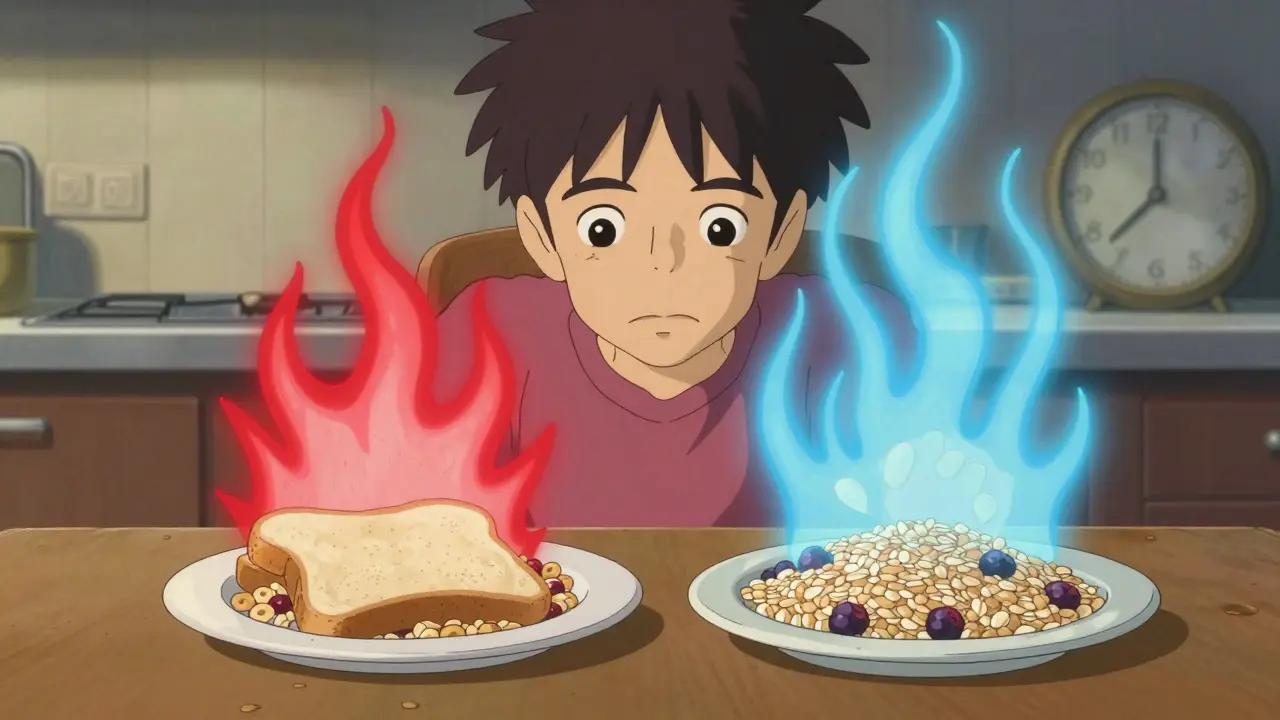
When you eat a bowl of white rice or a slice of white bread, your blood sugar spikes fast - and so does your insulin. That spike doesn’t just fade away. It often leaves you hungry again within a couple of hours, leading to snacking, overeating, and stubborn weight gain. But what if you could eat carbs without that rollercoaster? That’s the idea behind the low-GI diet. It’s not about cutting carbs. It’s about choosing the right ones.
What Is the Glycemic Index, Really?
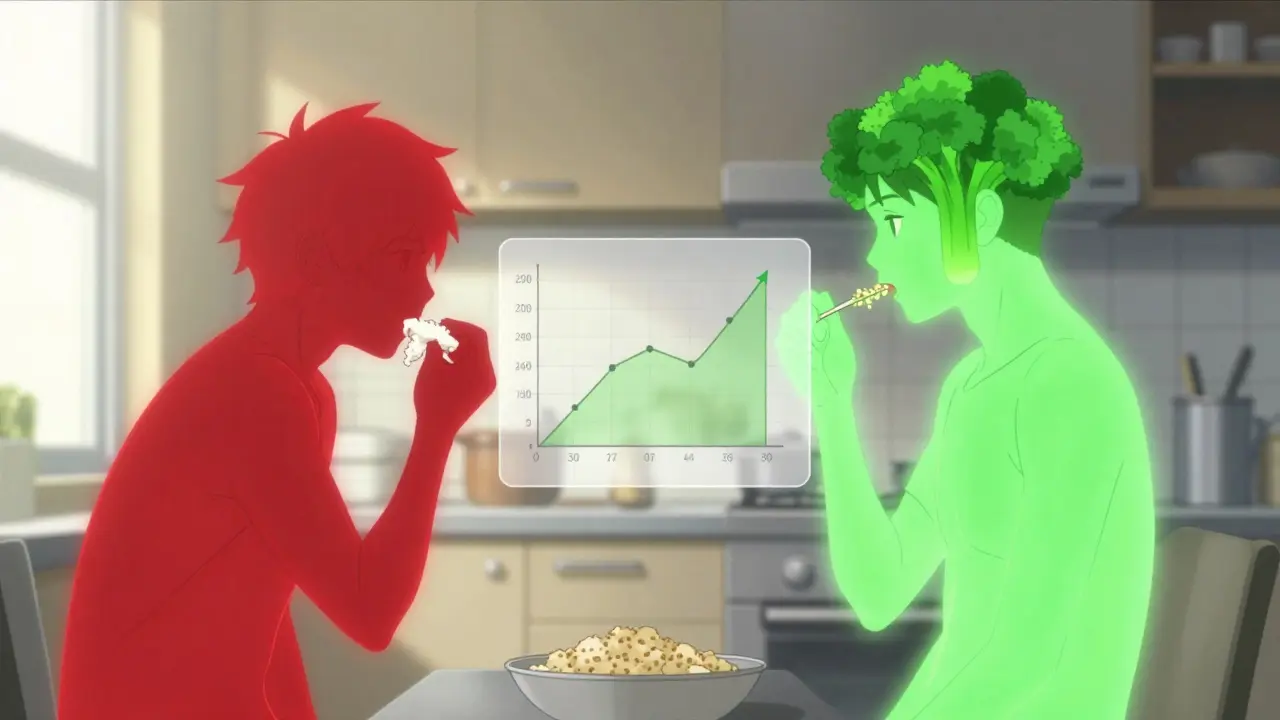
The glycemic index (GI) is a simple scale from 0 to 100 that tells you how quickly a food raises your blood sugar after you eat it. Pure glucose is the benchmark at 100. Foods below 55 are low-GI, 56-69 are medium, and 70 or higher are high-GI. This isn’t just theory. It’s based on real measurements from hundreds of clinical studies dating back to 1981, when Dr. David Jenkins and his team at the University of Toronto first mapped out how different foods affect blood glucose.Low-GI foods like lentils (GI=32), oats (GI=55), apples (GI=36), and broccoli (GI=15) break down slowly. They release glucose into your bloodstream gradually, keeping energy steady. High-GI foods like corn flakes (GI=81), white potatoes (GI=85), and white bread (GI=75) flood your system with sugar. That triggers a big insulin response. Insulin is the hormone that stores fat. When it spikes, your body holds onto calories instead of burning them.
Does Low-GI Help You Lose Weight?
Here’s where it gets messy. Many people assume low-GI = automatic weight loss. But the science says otherwise. A 2021 Cochrane Review looked at 17 studies involving over 2,000 people. The conclusion? When calories were kept the same, low-GI diets didn’t lead to more weight loss than high-GI diets. The same finding showed up in the 2018 DIETFITS trial - a $5.7 million NIH-funded study that tracked 600 adults for a year. Both low-GI and high-GI groups lost about the same amount of weight: roughly 6.5 kilograms.So why do some people swear by it? Because it’s not really about weight loss. It’s about control. Low-GI diets help you feel fuller longer. A 2019 study in the American Journal of Clinical Nutrition found that people eating low-GI meals had 30-40% lower blood sugar spikes after eating. That means fewer cravings, fewer snacks, and less mindless eating. If you struggle with constant hunger or afternoon crashes, this matters more than the scale.
The Real Advantage: Blood Sugar and Metabolism
The strongest evidence for low-GI diets isn’t about shedding pounds - it’s about preventing diabetes and heart disease. People with prediabetes or type 2 diabetes who switch to low-GI eating see measurable improvements. A 2019 review of 54 studies found hemoglobin A1c levels dropped by 0.5% on average - enough to move someone out of the prediabetic range. LDL (bad) cholesterol also fell by 4.7 mg/dL on average, according to the Academy of Nutrition and Dietetics’ 2021 review.Dr. David Ludwig from Harvard argues that low-GI diets may actually increase energy expenditure. His theory: lower insulin means your body burns more calories just to maintain basic functions. He cites a 50-100 kcal/day difference - roughly the amount of energy in a small apple. That doesn’t sound like much, but over a year, it adds up to 3-5 pounds of fat you don’t store.
On the other side, Karen Collins from the American Institute for Cancer Research says: “When calories are equal, GI doesn’t change fat loss.” She’s right - if you eat 1,800 calories of chocolate cake (GI=38) every day, you’re not losing weight. But if you eat 1,800 calories of lentils, vegetables, and whole grains, you’re eating more fiber, fewer refined carbs, and less added sugar. That’s not a low-GI diet. That’s a healthy diet.
What Foods Actually Belong on a Low-GI Diet?
Not all low-GI foods are created equal. Chocolate cake has a lower GI than a banana. Ice cream scores 37. That doesn’t make them healthy. The key is to focus on whole, unprocessed foods.- Low-GI staples: Barley (GI=25), oats (GI=55), quinoa (GI=53), lentils (GI=32), chickpeas (GI=28), beans (GI=20-40)
- Fruits: Apples (GI=36), pears (GI=38), berries (GI=40), oranges (GI=40), grapefruit (GI=25)
- Vegetables: Broccoli (GI=15), spinach (GI=15), carrots (GI=39), sweet potatoes (GI=54)
- Proteins and fats: Eggs, chicken, fish, nuts, seeds, avocado - they have no GI since they contain no carbs
Avoid these high-GI traps: white rice, white bread, instant oatmeal, sugary cereals, potatoes (especially mashed or baked), and most packaged snacks. Even “whole grain” bread can be high-GI if it’s finely ground. Look for chewy, dense bread with visible seeds - that’s usually lower GI.
Why the GI Isn’t Perfect - And What to Do About It
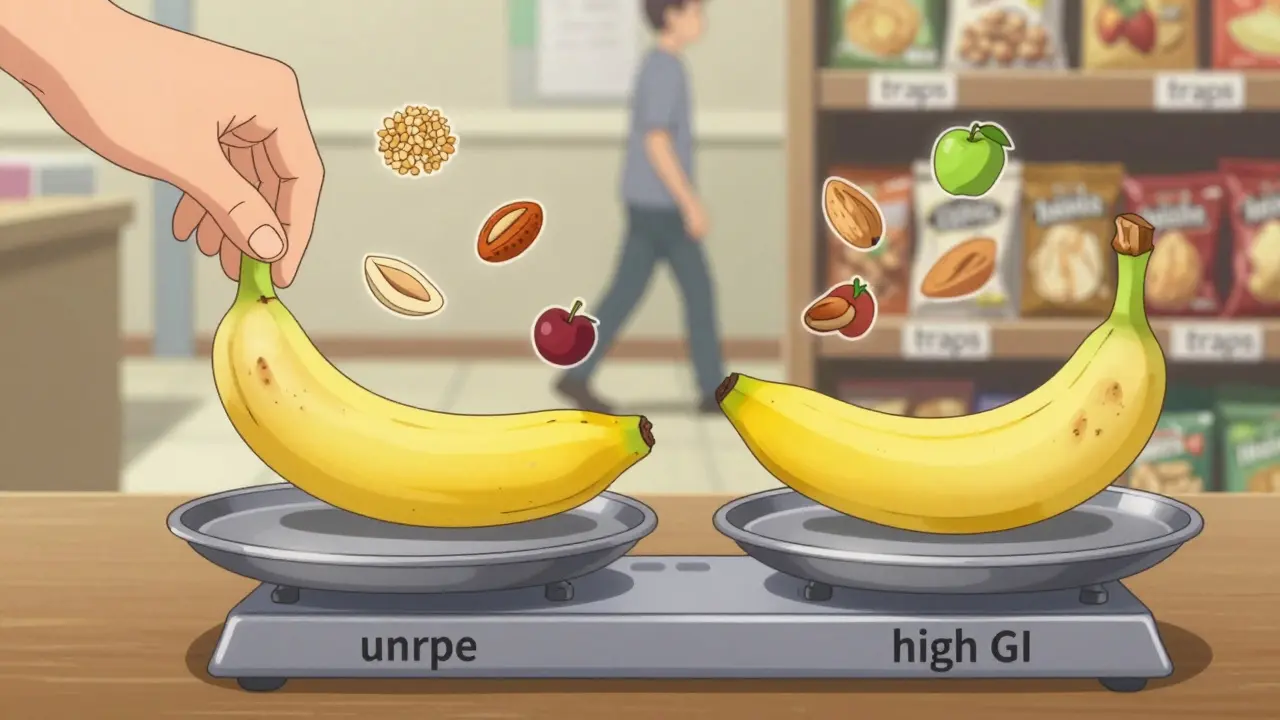
Here’s the biggest problem: your GI isn’t my GI. A 2015 study from the Weizmann Institute showed that two people eating the same banana can have blood sugar responses that differ by 20 points. Why? Gut bacteria, sleep, stress, activity level, even the time of day. Your body reacts differently than mine.That’s why rigid GI counting doesn’t work. A 2020 study in the Journal of Nutrition Education and Behavior found that most people take 2-4 weeks just to learn which foods are low-GI - and even then, they’re often wrong. Cooking changes everything. Al dente pasta has a GI of 45. Overcooked pasta? GI=65. A ripe banana? GI=51. An unripe one? GI=30.
So don’t obsess over numbers. Focus on patterns:
- Choose whole grains over refined ones
- Pair carbs with protein or fat (e.g., apple with peanut butter)
- Eat fiber-rich foods first - vegetables before rice
- Limit added sugar and processed snacks
The American Diabetes Association says it best: “Focus on the quality of carbohydrates, not the number.”
How to Start a Low-GI Diet (Without Going Crazy)
You don’t need a GI chart. You don’t need an app. Just make these swaps:- Swap white rice for barley or quinoa
- Choose steel-cut oats instead of instant
- Snack on nuts or Greek yogurt instead of crackers
- Use vinegar or lemon juice in salads - acid slows digestion
- Go for whole fruit instead of juice
Try this simple rule: if it’s white, refined, or packaged, skip it. If it’s colorful, whole, and close to nature, eat it. That covers 80% of what matters.
Who Benefits Most?
The low-GI diet shines for people with:- Prediabetes or type 2 diabetes
- Insulin resistance
- Metabolic syndrome
- Chronic hunger or sugar cravings
- High triglycerides or LDL cholesterol
If you’re just trying to lose 10 pounds without other health issues, a low-GI diet won’t give you an edge over any other balanced, calorie-controlled plan. But if you’re tired of energy crashes, afternoon binges, or fluctuating hunger, it might be the missing piece.
The Bottom Line
The low-GI diet isn’t a magic bullet for weight loss. But it’s a powerful tool for metabolic health. It doesn’t require calorie counting. It doesn’t ban entire food groups. It just asks you to choose slower-burning carbs - the kind that keep you full, steady, and energized.Forget the numbers. Focus on whole foods. Eat more vegetables, legumes, and whole grains. Cut out the white stuff. Drink water instead of soda. You don’t need to memorize GI scores. You just need to eat better.
And that’s something everyone can do - no chart, no app, no expensive foods required.
Is the low-GI diet the same as a low-carb diet?
No. A low-GI diet includes carbohydrates, but chooses ones that digest slowly - like oats, legumes, and whole fruits. A low-carb diet cuts carbs drastically, often replacing them with fat and protein. You can follow a low-GI diet with moderate carbs, while a low-carb diet usually means under 50-100 grams of carbs per day.
Can I eat fruit on a low-GI diet?
Yes, most fruits are low-GI. Apples, pears, berries, oranges, and grapefruit all score under 40. Bananas are medium-GI (30-51 depending on ripeness), but still fine in moderation. Avoid fruit juice - it spikes blood sugar fast because the fiber is removed.
Do I need to count GI for every meal?
No. Most people don’t need to. Focus on swapping out refined grains and sugary snacks for whole, unprocessed foods. If you’re eating mostly vegetables, beans, whole grains, nuts, and lean proteins, you’re already on a low-GI path. You don’t need to check a chart.
Why do some low-GI foods like ice cream still seem unhealthy?
Because GI only measures how fast sugar enters your blood - not the overall nutrition. Ice cream has a low GI because of its fat content, which slows digestion. But it’s high in sugar and saturated fat. A low-GI food isn’t automatically healthy. Always consider fiber, sugar, fat, and additives.
Can a low-GI diet help me avoid diabetes?
Yes. The World Health Organization says diets rich in low-GI carbohydrates can reduce type 2 diabetes risk by 15-20%. This is especially true when combined with weight management, physical activity, and avoiding processed foods. The key is long-term consistency - not short-term restriction.


Graham Holborn
Hi, I'm Caspian Osterholm, a pharmaceutical expert with a passion for writing about medication and diseases. Through years of experience in the industry, I've developed a comprehensive understanding of various medications and their impact on health. I enjoy researching and sharing my knowledge with others, aiming to inform and educate people on the importance of pharmaceuticals in managing and treating different health conditions. My ultimate goal is to help people make informed decisions about their health and well-being.