
When a pharmaceutical company spends over $2.6 billion to bring a new drug to market, it doesn’t do so out of charity. It does so because the law gives it a chance to get that money back - and then some. That’s where patent law comes in. But patents aren’t just about protecting big pharma. They’re the engine that makes generics possible. Without patents, there would be no generics. And without generics, most people couldn’t afford the medicines they need.
How Patents Work in Drug Development
A pharmaceutical patent gives a company exclusive rights to make, sell, and distribute a drug for 20 years from the date it’s filed. Sounds simple, right? But here’s the catch: most of those 20 years are gone before the drug even hits shelves. Clinical trials, FDA reviews, safety testing - all of that takes 8 to 12 years on average. So by the time a drug is approved, the company might only have 8 to 12 years left to profit before generics can enter.
That’s why the system was designed to give them back some of that lost time. Under the Hatch-Waxman Act a 1984 U.S. law that balanced patent protection with generic access, innovators can apply for patent term extension to make up for delays caused by regulatory review. This isn’t a loophole - it’s a deliberate trade-off. The government says: "You take the risk, spend the money, and we’ll let you recover."
The Birth of the Generic System
Before 1984, generic drug makers couldn’t even start developing a copy of a branded drug until the patent expired. That meant years of waiting - and no competition. The Hatch-Waxman Act changed everything. It created a legal pathway for generics to begin development while the original patent was still active. All they had to do was prove their version was bioequivalent - same active ingredient, same dose, same effect.
The real game-changer? The Paragraph IV certification. When a generic company files an application with the FDA, they can say: "We believe this patent is invalid or won’t be infringed." That triggers a 45-day clock. If the brand company sues, the FDA can’t approve the generic for up to 30 months. That’s not a delay to protect patients - it’s a delay to protect profits. But here’s the twist: the first generic to challenge a patent gets 180 days of exclusive market rights. No one else can enter during that time. That’s worth hundreds of millions of dollars.
Why Generics Are So Cheap
Once a patent expires and generics flood the market, prices drop hard. Like, 80% to 90% lower. Take Prozac. When Eli Lilly’s patent expired in 2001, its U.S. sales fell by $2.4 billion in a single year. The brand lost 70% of its market share. Today, fluoxetine - the generic version - costs less than $5 for a 30-day supply. The same drug, same chemistry, same effect. Just no marketing budget, no R&D costs, no patent protection.
That’s the power of competition. The FDA the U.S. agency that approves drugs and maintains the Orange Book listing patents has approved over 32,000 generic drugs. Today, 91% of all prescriptions filled in the U.S. are generics. But they only account for 24% of total drug spending. In 2022, generics saved the system $373 billion. That’s not just a number - it’s millions of people who can afford their insulin, their blood pressure pills, their antidepressants.
How Patents Are Being Stretched
But not every patent is about innovation. Some are about delay. This is where "evergreening" comes in. A company doesn’t invent a new drug - it tweaks the delivery method. A new capsule. A different dosage schedule. A new manufacturing process. Then it files another patent. And another. And another.
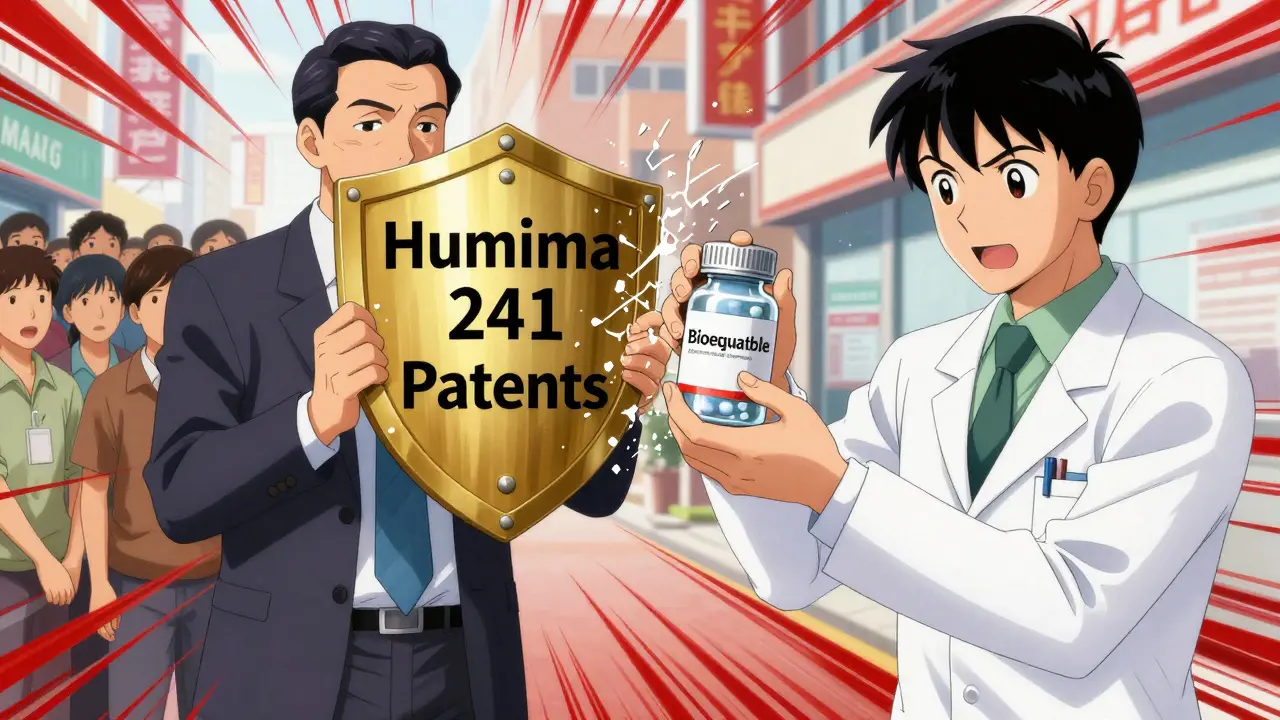
The most extreme example? Humira. That one drug has over 241 patents across 70 patent families. It was approved in 2002. But biosimilars - the biologic version of generics - didn’t enter the U.S. market until 2023. Why? Because the patent thicket was so dense, no one dared challenge it until the first key patent finally expired. Even then, it took years of litigation.
The Orange Book the FDA’s public list of approved drug products with patent and exclusivity information is supposed to bring transparency. But it’s also a weapon. Brand companies list every possible patent - even ones that are weak or unrelated. Generic companies have to sift through dozens just to figure out which ones to challenge. It’s expensive. It’s slow. And it’s designed to wear down competitors.
The Fight Over Pay-for-Delay
Here’s another trick: brand companies pay generics to stay out of the market. It sounds insane - why would a company pay someone not to compete? But it happens. A brand will offer a generic maker millions to delay its launch. These are called "pay-for-delay" agreements. The FTC estimates they cost consumers $3.5 billion a year.
The law says these are illegal. But they’re still common. Why? Because the 30-month stay under Hatch-Waxman gives brands leverage. If a generic challenges a patent and the brand sues, the FDA can’t approve the drug for 30 months - even if the patent is clearly invalid. So sometimes, the generic company just takes the cash and walks away.
That’s why Congress is trying to pass the Preserve Access to Affordable Generics and Biosimilars Act a proposed law aimed at banning pay-for-delay deals. It’s not about stopping innovation. It’s about stopping manipulation.
The Bigger Picture
Patents don’t stop innovation - they fuel it. Without the promise of exclusivity, no company would risk billions on a drug that might fail. But the system only works if the rules are fair. When patents are used to delay competition, not protect invention, the system breaks.
Generics aren’t the enemy. They’re the outcome of a well-functioning patent system. They’re the reason a diabetic in rural Ohio can afford insulin. The reason a veteran in Texas can get his heart medication without choosing between rent and refills.
The real question isn’t whether patents protect innovation. It’s whether we’re letting them protect the right kind of innovation - the kind that saves lives, not just profits.
Do patents prevent generic drugs from being made?
No - patents create the legal framework that allows generics to be made. Under the Hatch-Waxman Act, generic manufacturers can begin developing a copy of a branded drug even before the patent expires. They just can’t sell it until the patent runs out - unless they successfully challenge the patent in court. This system ensures that generics enter the market as soon as legally allowed, not before.
Why do generic drugs cost so much less than brand-name drugs?
Generic drugs cost 80%-85% less because they don’t have to repeat the expensive clinical trials that brand-name drugs go through. They only need to prove they’re bioequivalent - meaning they work the same way in the body. The original company already paid the $2.6 billion R&D cost. Generics just replicate the formula and sell it without marketing, branding, or patent protection.
What is the Orange Book and why does it matter?
The Orange Book is the FDA’s official list of approved drug products with their patent and exclusivity information. It’s critical because it tells generic manufacturers which patents they might need to challenge before launching their product. Without this transparency, generics wouldn’t know when or how to enter the market. But it’s also been used to create "patent thickets," where dozens of weak patents are listed to delay competition.
Can a generic drug company challenge a patent?
Yes - and they often do. This is called a Paragraph IV certification. When a generic company files its application, it can declare that a listed patent is invalid or won’t be infringed. This triggers a lawsuit from the brand company, which automatically delays FDA approval for up to 30 months. The first generic to successfully challenge a patent gets 180 days of market exclusivity - a huge financial incentive.
Are patents the reason drug prices are so high?
Patents themselves aren’t the direct cause - they’re the reason drugs exist in the first place. But when patents are extended through evergreening, pay-for-delay deals, or patent thickets, they become tools to delay competition. That’s when prices stay high longer than they should. The real issue isn’t patent protection - it’s patent abuse.
What’s the future of patent law and generics?
The Hatch-Waxman system is still the backbone of U.S. drug policy, with 97% of generics still using the Paragraph IV process. But pressure is growing. New laws like the CREATES Act aim to stop brands from blocking generic access to drug samples. Courts are also reviewing whether inter partes review (IPR) proceedings - where generics challenge patents at the Patent Office - are constitutional. The next decade will likely see tighter rules on pay-for-delay and clearer limits on evergreening.


Graham Holborn
Hi, I'm Caspian Osterholm, a pharmaceutical expert with a passion for writing about medication and diseases. Through years of experience in the industry, I've developed a comprehensive understanding of various medications and their impact on health. I enjoy researching and sharing my knowledge with others, aiming to inform and educate people on the importance of pharmaceuticals in managing and treating different health conditions. My ultimate goal is to help people make informed decisions about their health and well-being.