
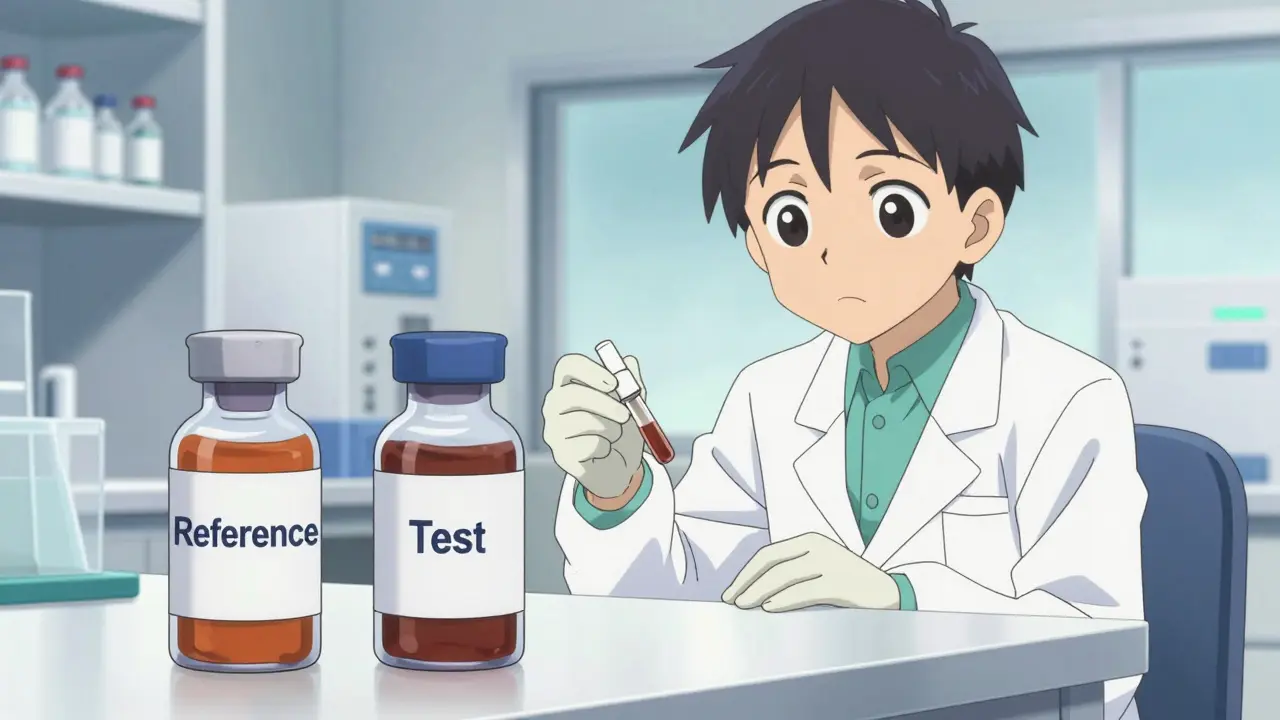
The Pre-Game: Selection and Pilot Testing
You don't just jump into a full-scale human trial. First, researchers must select the right players. The Reference Listed Drug (RLD) is the brand-name version that serves as the gold standard. Regulators usually require a single batch of the RLD, often chosen based on an intermediate dissolution profile from three different production lots to ensure it's a fair representation of the product.
Then there's the test product. This isn't a lab sample; it must be representative of commercial-scale production. The European Medicines Agency (EMA) generally requires these batches to be at least 1/10th of the production scale or 100,000 units. Before the main event, smart teams run pilot studies. These small-scale tests help assess variability. According to industry data, pilot studies can reduce the failure rate of pivotal studies from 35% to under 10% because they reveal if the drug is "highly variable" before the stakes get too high.
Designing the Study: The Crossover Gold Standard
Most Bioequivalence Studies use a two-period, two-sequence crossover design. Why? Because it's the most reliable way to eliminate individual biological differences. Instead of comparing Group A to Group B, every single volunteer receives both the test drug and the reference drug at different times.
Typically, 24 to 32 healthy volunteers are recruited. They are randomized into two groups: one group gets the generic first, then the brand name; the other group does the reverse. Between these two doses, there is a critical gap called the Washout Period. This period must be long enough-usually at least five elimination half-lives-to ensure the first drug is completely out of the person's system before the second one is administered. If you mess this up, you get "carry-over effects," and the whole study is essentially worthless.
| Design Type | Best For... | Key Characteristic | Typical Sample Size |
|---|---|---|---|
| Two-Period Crossover | Most systemic drugs | Same subject takes both drugs | 24-32 subjects |
| Parallel Study | Drugs with very long half-lives | Subjects only take one drug | Larger cohorts |
| Replicate Crossover | Highly variable drugs | Multiple doses of each drug | 50-100 subjects |
| Multiple-Dose Study | Modified-release formulations | Steady-state concentration | Variable |
Execution: Blood Sampling and Bioanalysis
Once the drugs are administered, the clock starts. Researchers collect blood samples at specific intervals to map the drug's journey through the body. You can't just take a few random samples; you need at least seven time points. This includes a pre-dose sample, one point before the peak concentration, two points around that peak, and three points as the drug leaves the system.
These samples are then analyzed using LC-MS/MS (Liquid Chromatography with tandem Mass Spectrometry), which is the industry standard for its extreme sensitivity. The goal is to measure two primary Pharmacokinetic Parameters:
- Cmax: The maximum concentration of the drug in the plasma. This tells us how quickly the drug is absorbed.
- AUC (Area Under the Curve): This represents the total drug exposure over time.

Crunching the Numbers: The 80-125% Rule
Collecting the data is only half the battle. The real magic happens in the statistical analysis. Biostatisticians use ANOVA (Analysis of Variance) to compare the geometric mean ratios of the test product versus the reference product.
For a generic drug to be approved, the 90% confidence intervals for both Cmax and AUC must fall within the range of 80.00% to 125.00%. If the result is 79% or 126%, the study fails. For drugs with a "narrow therapeutic index"-where a tiny change in dose could be dangerous-the window is even tighter, often between 90.00% and 111.11%. This strictness ensures that swapping a brand-name drug for a generic won't lead to a loss of efficacy or a spike in toxicity.
Alternative Paths and Biowaivers
Not every drug can be tested in a human crossover study. For some, there are alternative routes. For instance, Pharmacodynamic Studies measure the drug's effect on the body (like how warfarin affects blood clotting) rather than just its concentration. Clinical endpoint studies are used for things like topical creams, where the actual healing of the skin is measured.
Then there's the "holy grail" for manufacturers: the biowaiver. If a drug belongs to BCS Class I (high solubility and high permeability), regulators may allow a waiver of in vivo human testing if the manufacturer can prove the drug dissolves perfectly in a lab beaker (in vitro dissolution testing). This saves millions in costs and speeds up the time it takes to get affordable medicine to patients.

Common Pitfalls and Reality Checks
Even with strict guidelines, things go wrong. A common mistake is underestimating the washout period. If a drug has a 72-hour half-life and the researchers didn't wait long enough, the residual drug from the first period will contaminate the second, leading to a failed study and potentially hundreds of thousands of dollars in lost revenue.
Analytical failures are also rampant. Assay-related delays affect roughly 22% of studies. Whether it's a problem with the LC-MS/MS calibration or sample degradation, these technical glitches can stall an approval for months. This is why real-time PK sample analysis is becoming more popular; it allows teams to catch errors before the entire trial is compromised.
Why is the 80-125% range used for bioequivalence?
This range is a scientific convention that accounts for the natural variability in how different people absorb drugs. It ensures that the difference between the generic and the brand-name drug is not clinically meaningful, meaning it won't change the treatment outcome for the patient.
Can a drug be bioequivalent but not therapeutically equivalent?
In most cases, bioequivalence is used as a proxy for therapeutic equivalence. However, for some complex drugs or those with a narrow therapeutic index, regulators may require additional clinical data to ensure the generic version produces the same health outcome, not just the same blood concentration.
What happens if a bioequivalence study fails?
If the 90% confidence intervals fall outside the 80-125% range, the manufacturer must investigate the cause. Common fixes include reformulating the drug to change its dissolution rate or repeating the study with a larger sample size if the failure was due to high variability.
How many volunteers are usually needed for these studies?
For a standard crossover study, 24 to 32 healthy volunteers are typical. However, if the drug is highly variable, the number might increase to 50 or 100 to achieve enough statistical power to prove equivalence.
What is a biowaiver and who can get one?
A biowaiver allows a company to skip human bioequivalence trials. It is typically granted for drugs that are BCS Class I (high solubility and permeability) and show similar dissolution profiles to the reference drug in laboratory settings.
Next Steps and Troubleshooting
If you're a developer or a pharmacist looking at these results, always check the "Narrow Therapeutic Index" (NTI) status of the drug. If the drug is an NTI product, the standard 80-125% range isn't enough-look for the tighter 90-111% window.
For those managing trials, the biggest red flag is a high dropout rate. If more than 15% of your subjects leave the study, your statistical power drops, and you risk a "non-significant" result even if the drug actually is bioequivalent. To fix this, focus on subject comfort and shorten the hospitalization period where possible.
Graham Holborn
Hi, I'm Caspian Osterholm, a pharmaceutical expert with a passion for writing about medication and diseases. Through years of experience in the industry, I've developed a comprehensive understanding of various medications and their impact on health. I enjoy researching and sharing my knowledge with others, aiming to inform and educate people on the importance of pharmaceuticals in managing and treating different health conditions. My ultimate goal is to help people make informed decisions about their health and well-being.